Why Most AI Projects Fail - And How to Avoid It
Why Most AI Projects Fail Before They Start
Chatbot for support. Dashboard for sales. Maybe an AI tool that summarizes meeting notes. These are the first moves most businesses make — and most of them quietly get abandoned six months later.
Not because AI doesn't work. Because nobody stopped to ask whether those were actually the right problems to solve.
An IBM CEO study (opens in new tab) found that only around 25% of AI initiatives deliver expected ROI, and just 16% have scaled enterprise-wide. MIT's Project NANDA (opens in new tab) tracked over 300 AI initiatives and found that 95% of organizations deploying generative AI saw zero measurable return. The failure is almost never the model. It's what happened before the build started.
The Real Problem - Skipping Discovery
The pattern behind most failed AI projects is the same. Someone decides AI is the answer before they've defined the question. A tool gets selected, a vendor gets hired, and only then does anyone sit down with the people doing the actual work.
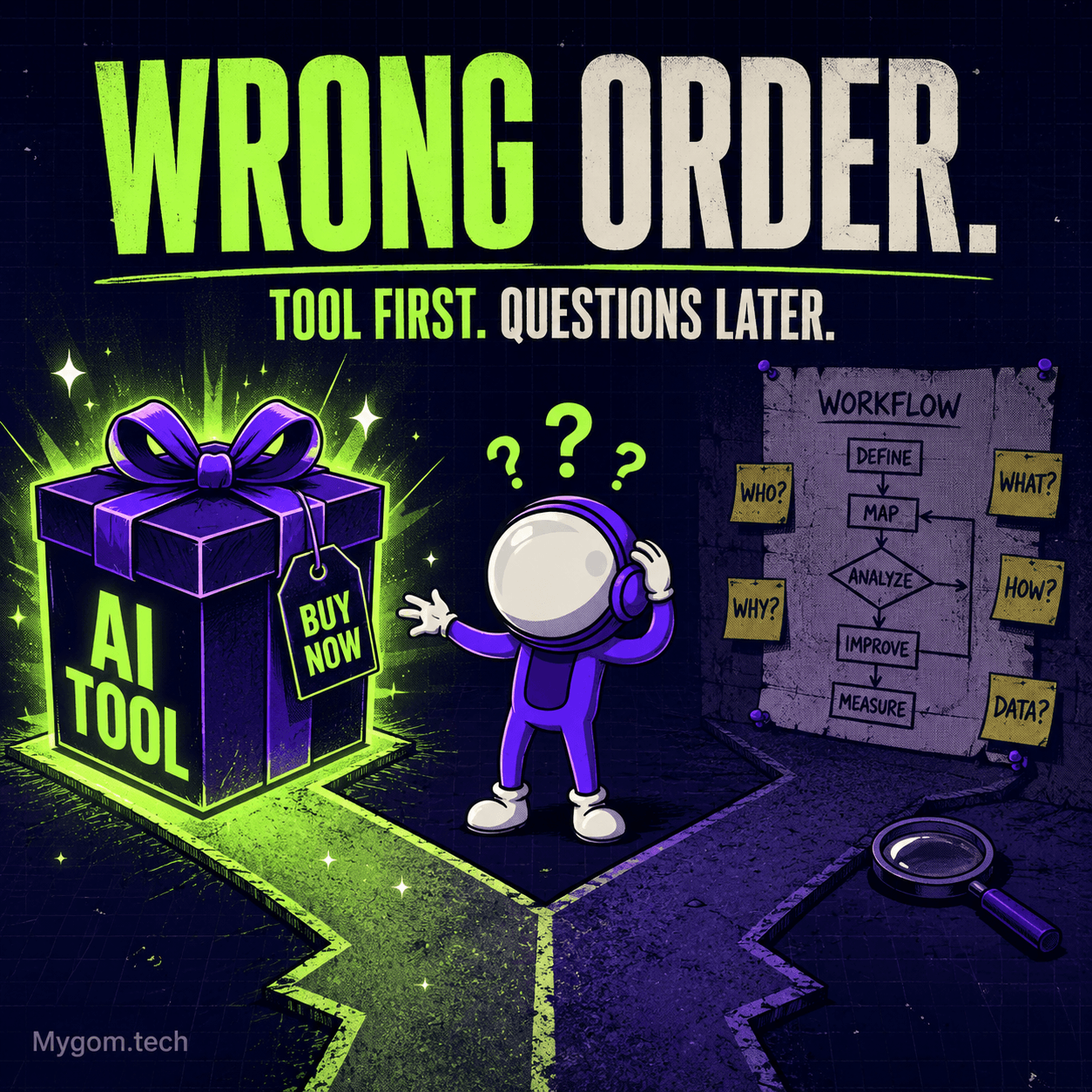
The most common reason AI projects fail (opens in new tab) is that they are launched without a clear business problem definition. When the mindset of "let's use AI" comes before answering "what problem are we solving and what value will we create," projects quickly lose direction.
According to a Gartner survey (opens in new tab) of 782 infrastructure and operations leaders, among those who deliver at least one successful AI use case, success is attributed primarily to integrating AI into existing workflows and securing full support from business executives - not to the technology itself.
The companies that get results don't start with tools. They start with workflows - real ones, not the idealised version on a process diagram.
What Good AI Project Discovery Actually Looks Like
The difference between AI that works and AI that doesn't usually comes down to what questions were asked upfront.
Not "what AI tools are available?" but: where does work actually slow down? Where do people have workarounds they've stopped noticing? What tasks get done inconsistently depending on who's doing them?
These questions don't live in a spreadsheet. They surface when you sit with the people doing the work - watching, listening, mapping the friction that's become invisible through familiarity.
PwC's 2026 AI predictions (opens in new tab) note that companies seeing real returns link business goals to AI capabilities through structured frameworks for assessing use cases, not by copying what competitors are doing, but by mapping unique pain points to targeted solutions.
That last part matters. Generic AI transformation doesn't exist. What exists is your specific process, your specific data, and your specific bottlenecks. Everything else is just someone else's solution to someone else's problem.
Our Example - From Manual Chaos to One Clean Workflow
We know what this looks like in practice because we've been through it ourselves.
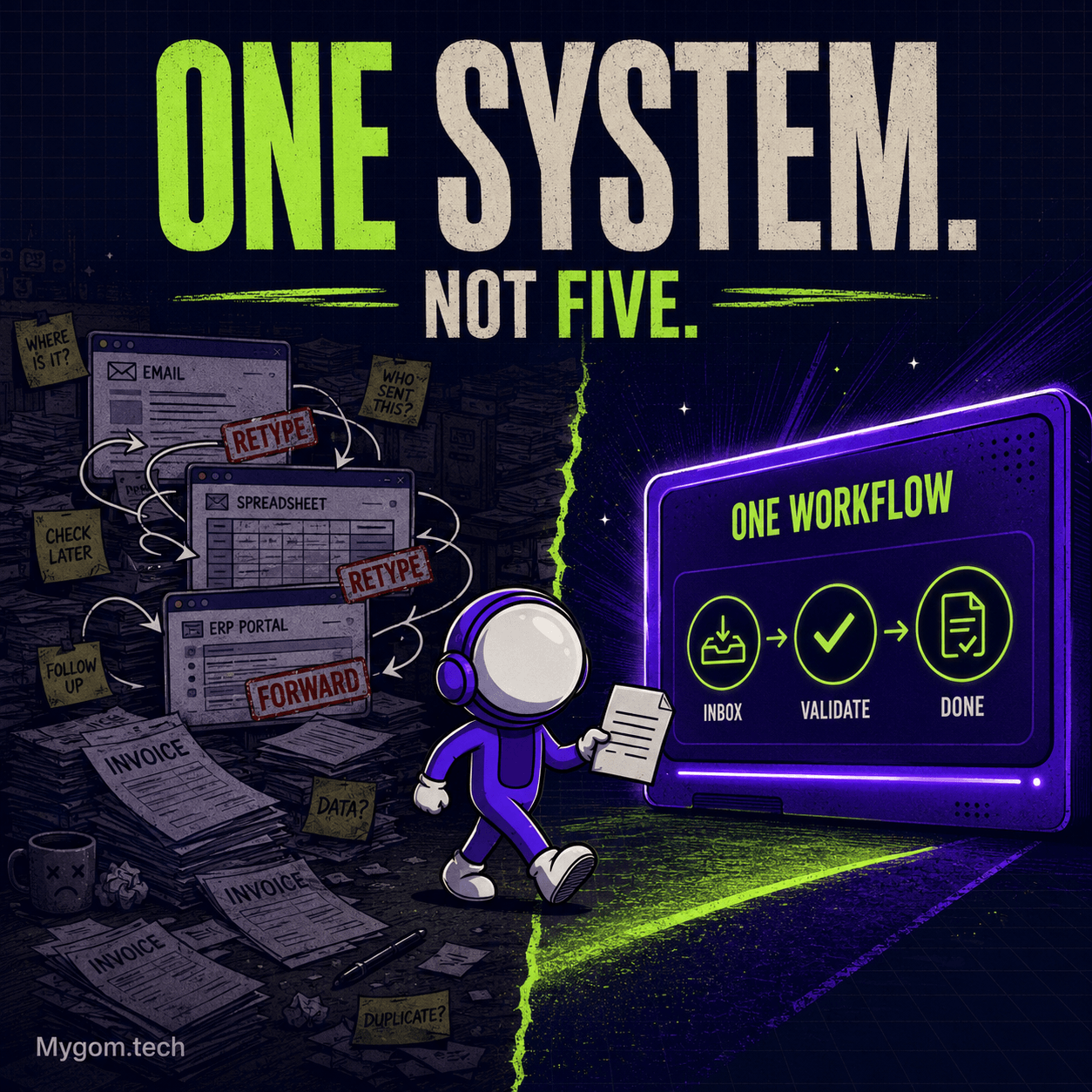
Our own invoice process was barely holding together. PDFs were being downloaded, renamed, forwarded for approval, and then retyped into another system. On a quiet week it looked manageable. When volume picked up, the whole thing started cracking.
The instinct in that situation is usually to add another tool - something for OCR, something for approvals, something to fill the gap. We pushed against that. Instead, we mapped the entire journey from when an invoice arrived through to final approval, identified exactly where the friction was, and built one workflow that handled all of it. No second tab. No new login.
The hardest part wasn't the build. It was staying disciplined about what not to add. There were plenty of nearby problems we could have solved and features that would have looked good in a demo. But the point was to fix the high-friction part - not to build a finance suite.
We built it for ourselves first, proved it worked, and now deploy the same tool (opens in new tab) for other teams facing the same problems we had.
That discipline - starting with real friction, building only what solves it, nothing more - is the same approach we bring to every automation assessment.
Where This Is Heading in 2026
Gartner projects (opens in new tab) that by the end of 2026, 40% of enterprise applications will include task-specific AI agents, and year-over-year spending on AI is expected to grow 31.9% between 2025 and 2029. The investment is accelerating regardless of whether the discovery work is done.
According to BCG (opens in new tab), companies plan to spend 1.7% of revenue on AI in 2026 - more than double the 0.8% spent in 2025. Yet less than 1% of executives report significant ROI.
That gap between spend and return is where most of the risk lives. And it's almost entirely avoidable if the right questions get asked before anything gets built.
What We Do Differently
At Mygom, we don't start with a tool recommendation. We start by understanding how your team actually works, where the time goes, where errors repeat, where people have built unofficial workarounds to get through the day.
From that, we identify which processes are genuine automation candidates: high volume, rule-based, currently manual, and painful enough that fixing them actually changes how people work. Then we build exactly that, and nothing more.
That's how AI gets adopted. Not because it was announced, but because it makes someone's day genuinely easier.
If you want to know where automation could make a real difference in your business - let's talk. (opens in new tab)
Gabriele J.
Marketing Specialist