AI training from a team task to a prototype
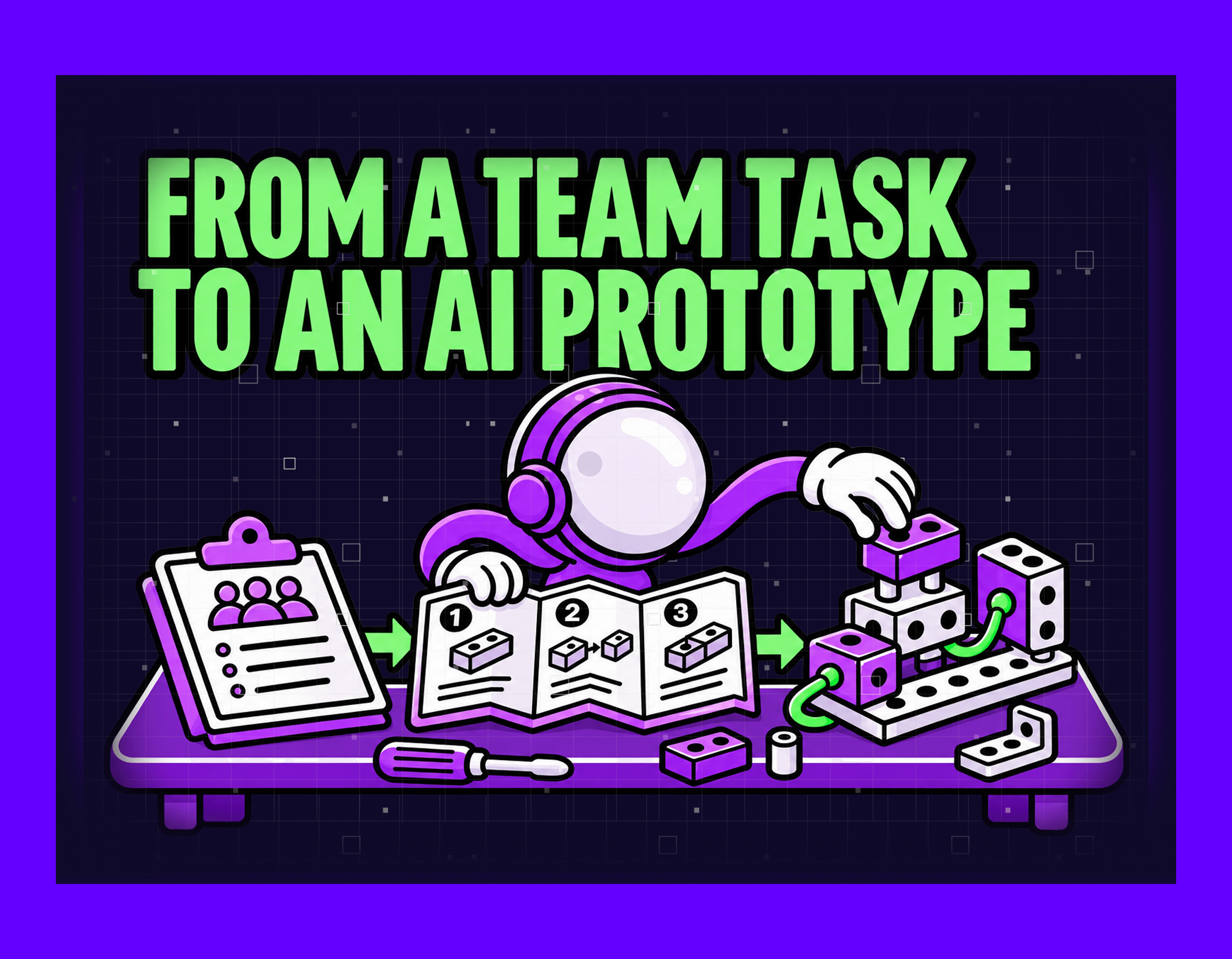
AI training from a team task to a prototype | MYGOM
A project manager opens her meeting notes to prepare an action plan. She needs to separate proposals from agreements and identify who owns each action. Practical AI training helps a team try that task, write useful instructions and judge whether the result reflects the source.
In MYGOM workshops, participants work with facilitators to build an agent prototype for a task agreed in advance. The exercise also produces working decisions: which information the tool needs, what it may do and where a person must check its output.
AI training starts with a task people can check
A manager should choose work with an observable result. Preparing actions from meeting notes gives participants something to compare with the original material. A broad ambition such as improving project management leaves the group without a clear test.
Before the session, we agree on work situations, approved tools, access and permitted practice material. Facilitators help select a manageable task. This preparation lets the team spend practice time testing ideas rather than searching for permissions or a suitable example.
A group can start by answering these questions:
- Which recurring output does an employee prepare, and what material supports it?
- How would a colleague decide whether the output is suitable for use?
- What information might be missing, and when must the tool ask a person for help?
Document comparison or organising information can also suit a workshop. The choice depends on the participants' experience and available tools. Selecting the company's most complex process is unnecessary when a smaller task can teach the same working principles.
A useful task also has boundaries. Preparing a meeting action plan does not automatically include assigning work in another application or notifying colleagues. Agreeing on those limits helps participants distinguish a draft from an authorised action.
A worked example makes the instruction testable
Consider an employee turning meeting notes into an action plan. This is a teaching example, not a report of a client's results. Asking AI to tidy the notes leaves the expected output and the limits unclear.
A more useful instruction could say:
From the supplied notes, prepare an action table with the task, responsible person and deadline. If the notes do not name a person or deadline, mark it as unspecified. Do not add new agreements.
The instruction identifies the source, output format and treatment of missing information. Participants can then inspect the response against the notes. An action does not become an agreement simply because the tool presents it in a well-formatted table.
Anthropic's context engineering guidance (opens in new tab) considers instructions alongside tools, external information and conversation history. For the group, this supports a practical question: which information does the chosen task actually require?
The team can test a revised instruction against another permitted example. If an owner remains unclear, the output should preserve that uncertainty. Employees still need to check the result and decide whether it represents the meeting accurately.
The team game exposes decisions worth discussing
Participants get a shared situation they can examine together. Teams play MYGOM's game on their phones, using a scenario whose context we adapt to the company's work. The exercise gradually introduces more AI capabilities.
Groups begin without AI, then try a conversation, saved instructions, connections and an agent. They compare the working process and result as those capabilities change. An important observation may be where the tool presents an incorrect assumption convincingly.
Facilitators use the discussion to return to specific choices. Which instruction helped? Where did the team accept an assumption without checking it? Participants turn those observations into working principles before starting their own practical task.
For the meeting example, the group might agree that a missing deadline must stay unspecified. That decision creates an observable check for the next attempt. A general reminder to use AI carefully would give participants less guidance about the expected behaviour.
The hackathon turns the task into a prototype
Facilitators help small groups apply the principles to their selected work situation. Participants define the desired result, prepare instructions and run the prototype against an agreed example. Practice uses approved tools and prepared connections.
For meeting notes, a group could describe how to identify agreed actions and report missing information. Saved instructions allow participants to reuse that working method with another example. Where the task and available connections permit it, the group can also explore tool access.
A saved instruction alone does not establish an autonomous agent. OpenAI's practical guide to building agents (opens in new tab)describes systems that manage workflow execution and use tools within defined guardrails. During practice, we distinguish these capabilities and consider which ones the selected task needs.
Participants do not need to connect every available tool. Testing may show that a conversation and reusable instructions already support part of the job. Understanding that limit helps the team decide where building an agent would add value.
The prototype gives the group a result to inspect, rather than an abstract discussion about automation. Facilitators help participants compare it with the original goal and adjust their instructions. The work also identifies questions that remain unanswered.
The team should be able to repeat the working method
Teams leave with a prototype tried in the training environment, its instructions and a list of further checks. AI training is useful when participants can also explain their choices. They should be able to identify the information used, explain the instruction and describe how they judged the result.
For the meeting task, later checks might use differently structured notes or conflicting agreements. A colleague would examine whether the prototype identifies the uncertainty. The practical result depends on the task, data and tool capabilities.
A day of practice lets a group try a working method without establishing that it suits every company situation. Production deployment, programming and individual integrations with company systems sit outside the training scope. The team needs additional checks before using its prototype routinely.
A colleague should be able to follow the saved instructions and understand the limits recorded during practice. That makes the next attempt easier to review together. Our production guide to building an AI agent (opens in new tab) discusses the wider implementation and testing decisions.
A manager can support the next attempt by assigning an owner to the selected task. That person can keep the instructions and observations together. The team then has a clear basis for deciding what to test again.
When a workshop is not the right next step
The format should match the group's experience and the problem it wants to solve.
- If employees already define tasks clearly and check outputs consistently, a focused practice session may be more useful. They do not necessarily need the full programme.
- If the company needs a working integration with its business system, assess the development and deployment separately. A training day does not deliver that implementation.
- If participants cannot use the chosen material or tools, resolve permissions first. Ordering a workshop does not grant access to company data.
Where to start
Choose a recurring task and note how an employee would check its result. You do not need to send sensitive or personal information for an initial discussion.
The MYGOM team agrees on practice scope, preparation and tools according to the participants' experience. AI training can then focus on a defined work situation and an outcome the group can evaluate.
Contact us (opens in new tab) to discuss which team task would suit a practical workshop.