Choose IT Consultants Without Blowing Budget

Imagine a trusted guide walking into your office at just the right moment when things feel stuck.
You know something's off - systems keep falling, teams stretch thin, growth stalls, but you need clarity. You just need someone to help make sense of it all. That's where IT consulting comes in. An IT consultant looks at your toughest problems and tells you what to fix. They turn "Where do we start?" into "Here's your next step."
IT consulting isn't just for global giants. Startups face the same dragons - data scattered across platforms and outdated processes that slow you down. Recent research (opens in new tab) by MOR Software indicates that typical IT consulting rates often range from approximately $50 to $250 per hour, depending on experience, region, and specialization. With stakes this high, every choice is important.
However, here's what stalls most teams - they dive right in without a plan. They hire consultants before defining their problems or mapping budgets. That's how costs spiral, and projects stall. Ratcliff IT notes (opens in new tab) this often leads to unnecessary expense through inefficient scoping.
This guide breaks it all down for you - no fancy terms, just the steps that work for teams like yours. You'll learn how to spot your business challenges, set realistic budgets, create timelines, and involve the right people from day one. By the end, you'll know exactly what to prep before calling in an IT consultant, and how to turn expert advice into changes that stick to your team. Ready to see what happens behind the curtain? Let's get started.
Prerequisites
Before you contact any IT consultant, you need these basics in place:
1. A clear problem statement. Write down what's broken or missing. Be specific. "Our invoices take three days to process" beats "We need better systems."
2. Budget boundaries. Know your spending limit. Even a rough range helps - a range of $10K to $30K gives consultants room to propose solutions.
3. Key stakeholders identified. List who needs to approve decisions. This includes finance, operations, and IT leads. Get their buy-in early.
4. Access to current systems. Gather login credentials, system diagrams, and vendor contacts. Consultants can't help if they can't see your setup.
5. Timeline expectations. Do you need results in three months or twelve? Set a realistic deadline based on your growth plans.
You should now have a foundation ready. Without these five items, consulting projects drift off course.
Checkpoint: Review this list with your leadership team. Confirm that everyone agrees before reaching out to consultants.
Understanding IT Consulting Services and Costs
How Consulting Fees Are Structured
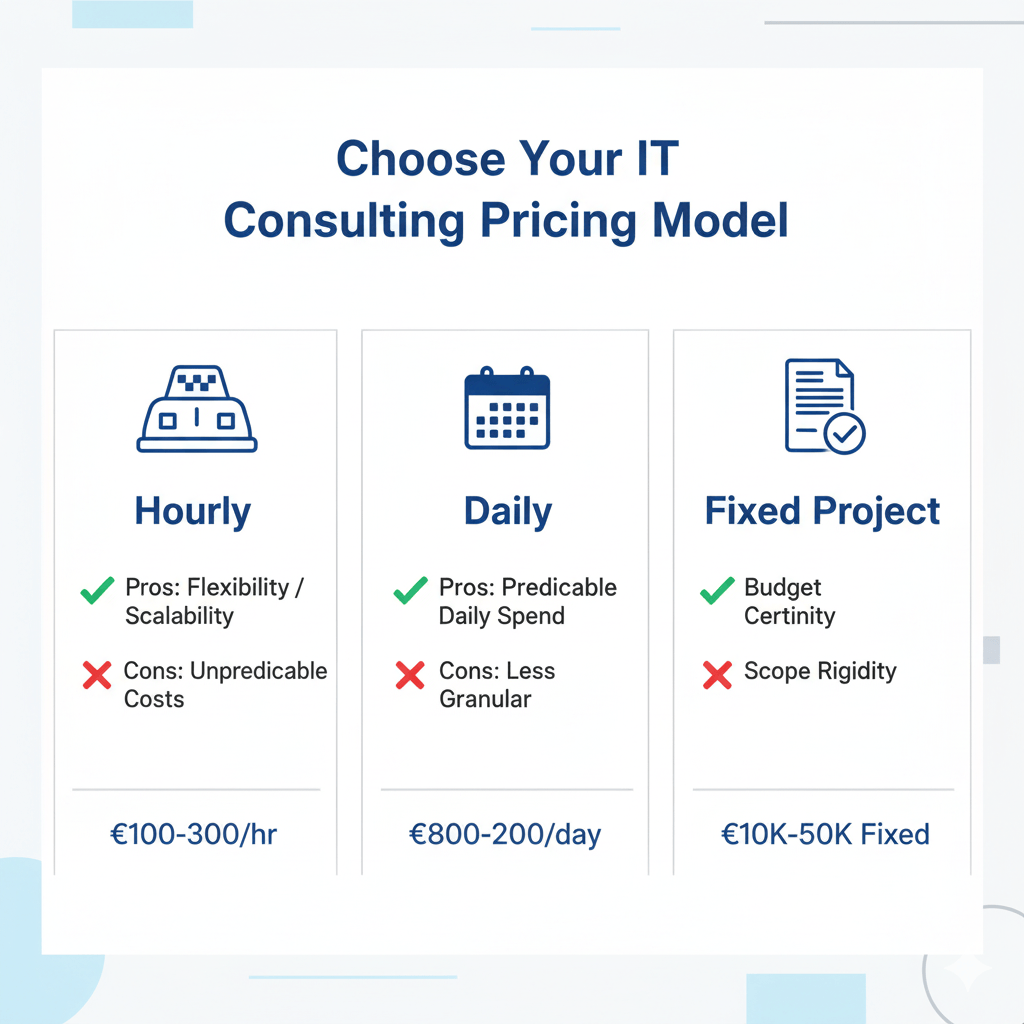
Start by picking a pricing model that fits your project. Most IT consulting fees are set in one of three ways: hourly rates, daily rates, or fixed project pricing. Each has its own strengths.
- Hourly rates work like a taxi meter. You pay for every hour the consultant works. This gives you flexibility. If your needs change mid-project, you adjust without renegotiating a full contract.
- Daily rates give you predictable costs. If your project needs full-time attention over days or weeks, you know exactly what each day costs. No surprises at the end.
- Fixed project pricing sets a total fee for a defined scope. You agree on deliverables up front. The consultant handles the rest. Your risk drops because you know the final bill before work starts.
For example, say you need cybersecurity advice for two weeks. If you pick an hourly model and the consultant charges $180 per hour, you're billed only for the actual time spent. But if your project is well-defined, like migrating servers, a fixed fee can reduce risk.
You should now see a clear choice between flexibility (hourly) and predictability (fixed).
Checkpoint: Before moving on, verify that all parties agree on the billing method. This avoids disputes later.
Hourly Rates vs Project Pricing
Next, compare how each option impacts your budget and timeline. Hourly rates are common for ongoing support. They work when requirements might change along the way. For instance, experienced freelance consultants charge anywhere between $100 and $300 per hour. It depends on skills and location.
Project-based pricing is suitable for larger tasks with fixed requirements. It often includes milestones tied to specific deliverables. For example, building a custom CRM system may cost $20,000 as a fixed fee. It doesn't matter how long it takes.
Expect greater control with hourly billing. But you get less certainty on total spend if the scope grows. With fixed projects, confirm every deliverable up front. This avoids costly add-ons down the road.
You should now know which option fits your risk comfort level and cash flow situation.
Checkpoint: Review sample contracts before signing. Ensure they outline rate structure and scope changes clearly.
Factors Affecting IT Consulting Fees
Several factors shape what you'll pay for IT consulting services and costs:
1. Location. Rates vary widely by country or even city. U.S.-based consultants may charge double compared to Eastern Europe.
2. Expertise. Highly specialized skills cost more. AI strategy work outpaces basic helpdesk support by 2-3x.
3. Project Complexity. The more complex your project is, the higher the average cost climbs. Integrating five legacy systems costs more than setting up email.
4. Firm vs Freelancer. Large consultancies bring bigger teams but also higher overheads. Freelancers offer lower rates but limited capacity.
For example, Ratcliff IT (opens in new tab) notes UK firms typically charge between £80 - £200 (~$106 - $267) per hour. It depends on service depth and demand.
What's reasonable? The answer depends on value delivered, not just hours booked. Guardian IT found (opens in new tab) engineering firms in North America often pay between $120 - $250 per hour on average. Always balance price with proven results before making your final selection.
At this point, you should understand what drives consulting fees. You also know where your own needs fit into that range.
Checkpoint: Gather quotes from at least two providers before proceeding. Compare not just price but also reputation and past results.
Step 1: Define Project Scope and Requirements
Start by mapping your project like an architect sketches blueprints. List every feature, integration, and business rule you need. For example, if you want a billing portal with automated reminders, note each function in detail.
Write down specifics:
- "Automated emails sent daily at 9:00am"
- "Admin dashboard with real-time invoice tracking"
- "Integration with Xero API"
Break down the work into phases. Discovery comes first. Development follows. Testing wraps it up. Assign priorities so consultants can quote accurately for IT consulting services and costs.
Share real data where possible. Say "200 invoices per month" instead of "lots of invoices." Say "integration with Xero API" instead of "accounting software connection."
Use this checklist:
- List all must-have features. Separate them from nice-to-have features. Be honest about what you can delay.
- Specify user numbers. How many people will use the system? Five users need different infrastructure than five hundred.
- Outline integrations. List every third-party system involved. Include APIs, databases, and legacy tools.
- Note security needs. Do you handle payment data? Medical records? Each requires different compliance standards.
- Set launch deadlines. Give realistic dates tied to business milestones. "Q2 launch to support new client onboarding" is better than "ASAP."
You should now have a requirements brief ready to share. At this point, your potential consultant can give precise estimates instead of ballpark figures.
Checkpoint: Verify that your list includes user types, third-party systems involved, and measurable outcomes before requesting quotes.
Step 2: Compare Consulting Rates and Fee Structures
Check current consulting rates in your region and industry niche before you negotiate anything. Data from industry sources shows entry-level consultants may charge between $25 to $50 per hour. This works for simple support tasks or startups needing guidance.
More experienced IT specialists often use tiered models:
- Hourly rate. Best for open-ended work. You pay as you go. Flexibility is high. Budget certainty is low.
- Fixed fee. Best for clear deliverables. You agree on a total price up front. Budget certainty is high. Flexibility is low.
- Retainer. Best for ongoing partnership. You pay a monthly fee for priority access and set hours. This locks in support without runaway costs.
For example, if you need ad-hoc troubleshooting during product launches, a retainer structure can lock in priority access. You won't see surprise bills at month-end.
A Ratcliff IT (opens in new tab) breakdown reveals that mid-tier providers will often offer blended rates. This is a mix of hourly plus milestone bonuses. It handles complex scenarios without scope creep.
Ask each candidate these questions:
- Do you bill hourly or by project? Get clarity on the primary model before discussing details.
- What's included in the base rate? Does it cover emails and calls? Or only hands-on work?
- Are there surge charges for after-hours support? Emergency fixes often cost 1.5x to 2x standard rates.
- How do you handle scope changes? If new features pop up, what's the process to add them?
Checkpoint: At this stage, compare proposals side-by-side. Look not only at cost per hour but also what's bundled - response times, revisions, documentation.
Step 3: Negotiate Terms for Complex Projects
Move into negotiation once you understand both the scope and typical consulting rates for similar work. Approach it like haggling over a car, but with more clarity than bluffing.
Start by highlighting where flexibility exists. Say "We could phase out non-critical features if needed." This shows you're realistic about budget limits while keeping core goals intact.
Use real examples when discussing pricing. For instance, Guardian IT found (opens in new tab) average consulting costs ranging from $100 to $300 per hour for engineering firms. Use these benchmarks as anchors during conversations about fair pricing on complex projects.
Negotiate value-based terms:
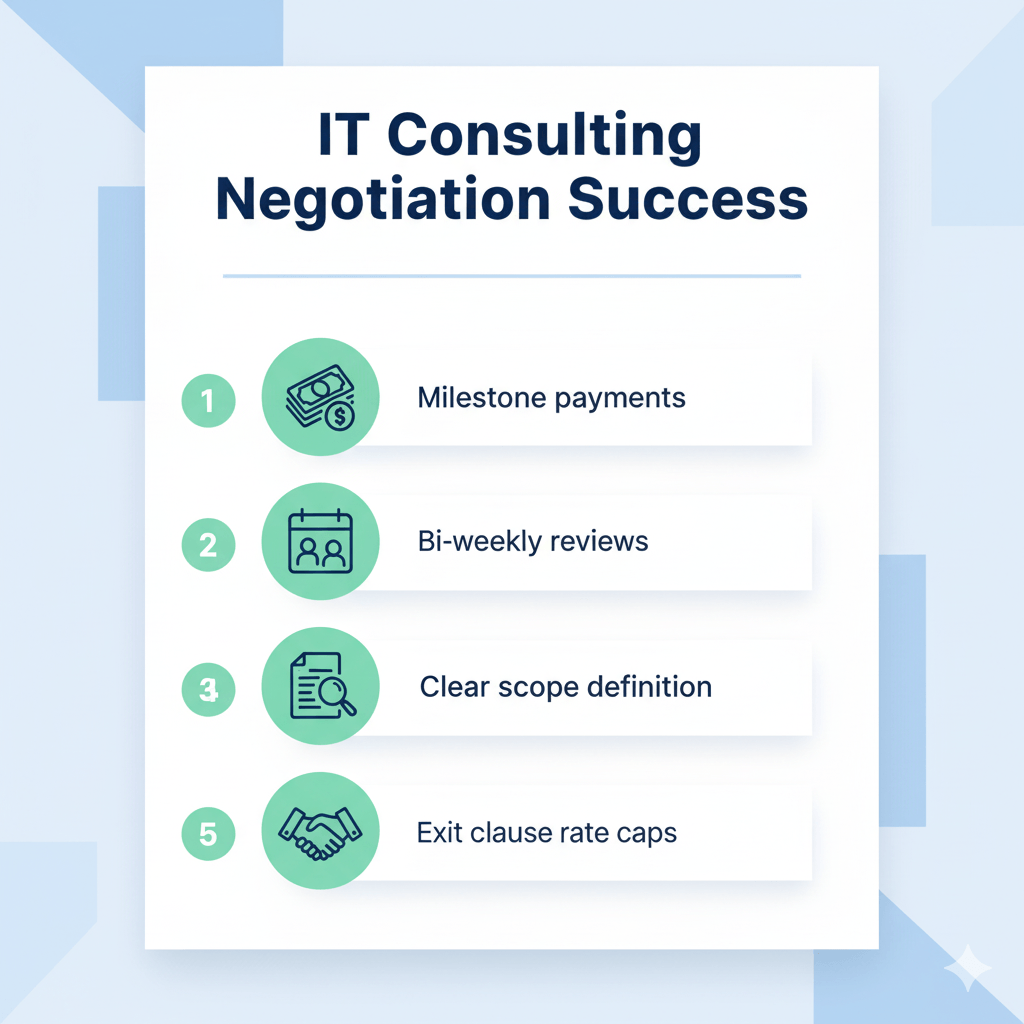
- Tie payments to deliverables. Say "30% upfront; remainder after successful handoff." This protects both sides. You don't pay until you see results. They get some capital to start work.
- Build in review periods. Schedule bi-weekly demo days to adjust priorities. This keeps everyone aligned as the project evolves.
- Request escalation clauses. If additional hours are needed beyond estimate, agree on reduced overtime rates up front. For example, standard work might be $150 per hour. Overtime could be $120 per hour if you commit to a minimum number of extra hours.
At this point, your agreement should reflect both parties' understanding of workload and risk-sharing. It's not just raw hours worked.
Checkpoint: Confirm the final contract lists all deliverables by milestone. It should have clear language about extra charges before signing anything related to IT consulting services and costs.
When finished here, you'll have a consultant who knows exactly what problem they're solving. You'll have a price model that fits your business reality. No hidden surprises. No runaway invoices down the road.
Common Pricing Mistakes and How to Avoid Them
Underestimating Project Scope
Start by clarifying every project requirement with your IT consultancy. List deliverables, milestones, and expected outcomes in detail. For example, if you need both cloud migration and staff training, specify each one. Many businesses fall into the trap of vague requirements. This results in added costs later.
Request a written breakdown of tasks from your provider. Check each item matches your business goals before signing the contract. If anything feels unclear or missing, ask for clarification immediately.
You should now have a detailed proposal with no gray areas. Verify that the timeline includes all phases you discussed. This means not just initial delivery but also post-launch support.
According to Ratcliff IT (opens in new tab), clearly defining your project’s scope is essential for getting accurate cost estimates and avoiding unexpected expenses as requirements change.
Ignoring Hidden Costs
Review every line item in your quote for vague fees or extras labeled as "optional." For example, travel expenses, software licenses, or ongoing maintenance may not be included in base pricing.
Ask your consultant to explain any terms like "incidental charges" or "support retainer." Request these be listed with exact costs attached.
Check if there are extra fees for after-hours work or emergency fixes. A Guardian IT (opens in new tab) study highlights that hidden costs like licensing, infrastructure upgrades, storage, compliance, and training can significantly increase the overall price of IT consulting if they are not planned for upfront.
At this point, your contract should reflect all expected expenses - both core and peripheral. Verify that nothing is left as "TBD" before committing funds.
Misunderstanding Hourly vs Fixed Fees
Determine which fee structure matches your needs best. Hourly rates give flexibility but can lead to creeping budgets. Fixed project fees offer predictability but require tight scoping up front.
For example, $175 per hour is common in the US market for advanced expertise. Other regions may charge less depending on specialty and demand.
The rule of 3 in consulting suggests getting at least three bids before deciding. It helps you line up bids fairly, spotting weird pricing or hidden extras. It helps you spot outliers in rate structures or hidden fees.
Is $100 an hour good for consulting? It depends on location and experience. Rates vary (opens in new tab) widely by skill set and complexity. Always benchmark against the average cost of similar services locally before agreeing on terms.
By following these steps, you protect your budget. You get clarity on what's actually included with IT consulting services and costs.
Success Criteria: How to Know You're Ready
You're ready to engage an IT consultant when you can answer "yes" to these questions:
- Have you written down the specific problem you need solved? Not "improve our tech" but "reduce invoice processing time from 3 days to 3 hours."
- Do you have a realistic budget range with stakeholder approval? Your finance team has already signed off on spending limits.
- Have you gathered quotes from at least two providers? You've compared not just price but also reputation, response time, and past results.
- Is your scope document clear enough that three different consultants would quote similar hours? Vague requirements lead to vague estimates.
- Do you have access to current systems and data? Consultants need to see your setup to give accurate advice.
If you answered "yes" to all five, you're ready. If you answered "no" to any, go back and fix that gap before signing a contract.
Checkpoint: Share this checklist with your leadership team. Make sure everyone agrees you're ready to move forward.
Conclusion
You now have a clear path for choosing IT consultancy partners and making an informed choice. By checking references, reviewing case studies, and asking direct questions about delivery methods, you separate proven partners from empty promises. Use your checklist to vet experience, technical fit, communication style, and transparency. These traits reveal more than any slogan or portfolio slide.
Move forward by shortlisting consultancies that pass this test. Schedule discovery calls focused on your goals and real challenges - not their credentials alone. Insist on concrete next steps: pilot projects, transparent contracts, measurable milestones. When both sides agree on outcomes before work begins, surprises turn into solutions instead of headaches.
The right consultancy is not just a vendor. They become the guide in your story of change. Top-tier expertise commands premium rates, but the payoff is lasting change and business growth.
Your journey starts with clarity and ends with results you can measure. Trust the process - and trust yourself to choose well from here.
If you’re planning an IT project and want help applying this checklist to your own situation, get in touch with our team (opens in new tab). We’ll walk through your goals, review potential partners, and help you structure a consulting engagement that fits your scope, budget, and timeline.
Gabriele J.
Marketing Specialist