Loading products
- ai agent
- available
Marketing that sees the full path to a real business outcome
We build the agent around your channels, website behaviour, CRM and decision process. It finds where results are being lost, recommends a direction and, with your approval, helps put it into action.
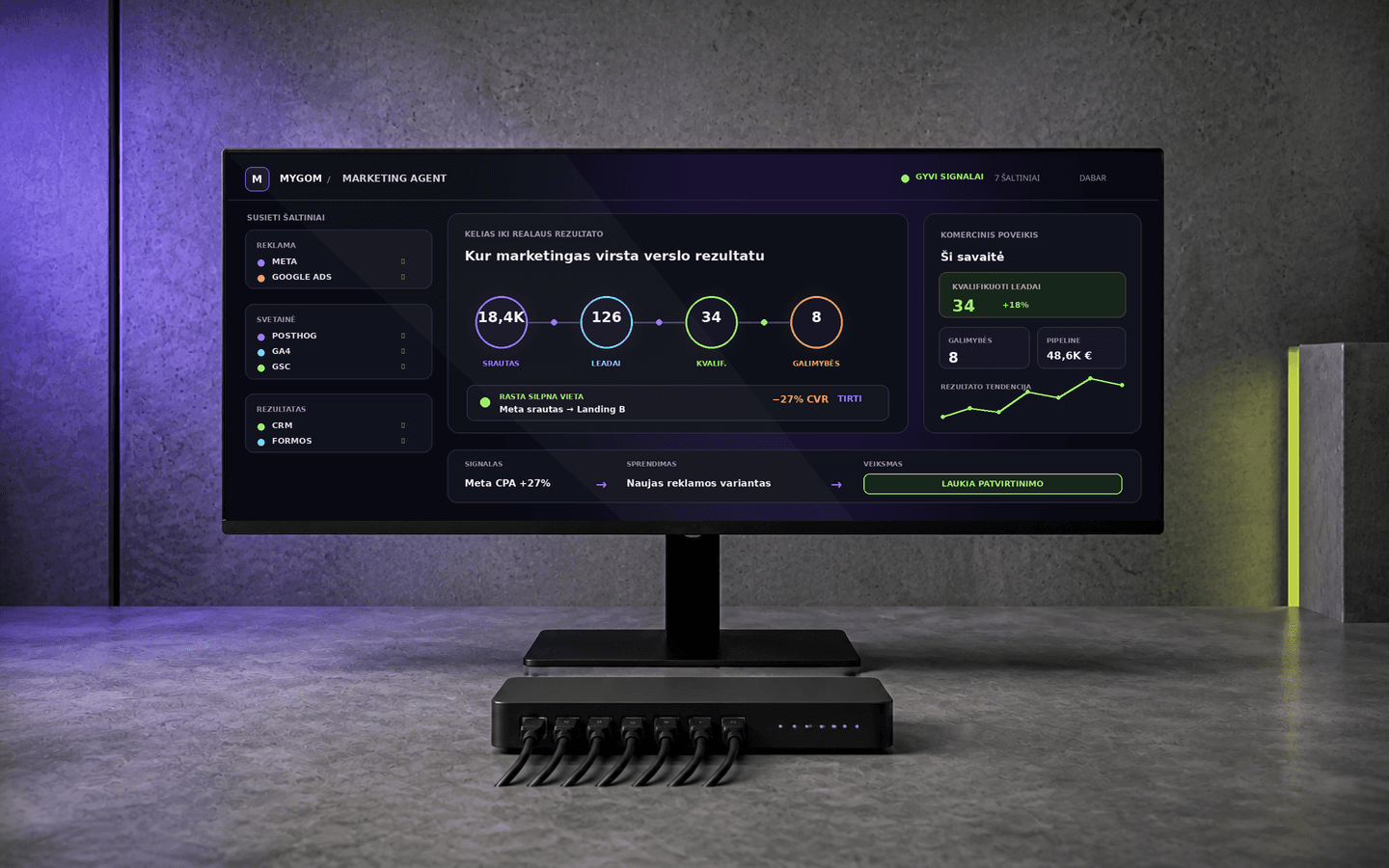
Fewer reports. Clearer decisions.
The agent connects channel metrics with what actually happened in the business.
See the full path to revenue
Ad impression, visit, form, CRM lead, proposal and sale become one decision context.
Know where results are being lost
The agent separates a weak ad from poor traffic, a slow page, an unclear offer or a broken sales hand-off.
Move budget using evidence
Channels, campaigns and audiences are compared against real business results, not clicks or platform-attributed conversions alone.
Give the team a clear next move
Every finding ends with a specific action, owner, metric and review point.
Keep the lesson from every test
Hypotheses, changes and outcomes stay in the system, so the next decision starts with accumulated context.
One agent sees the whole marketing system
We connect the sources your team actually needs. Each one answers a different question.
Channel performance
Compares spend, impressions, clicks, conversions and campaign trends across Google Ads, Meta and your other active channels.
Website behaviour
Uses PostHog to see what visitors do after the click, where they stop, what they use and where they leave the funnel.
Lead quality and revenue
CRM and real form-delivery records show which sources produce qualified leads, proposals and sales, not merely submissions.
Organic demand
Search Console shows what people search for, which pages are growing, where CTR is being lost and which topics are missing.
Measurement quality
Checks events, UTM tagging, conversion goals and disagreements between sources before the team acts on bad measurement.
Competitor activity
Researches public ads, landing pages, offers, content themes and market changes while keeping observed facts separate from estimates.
Content direction
Turns search demand, website behaviour, campaign performance and sales questions into a prioritised content plan.
Risks and anomalies
Spots sudden changes in spend, traffic, conversions, indexing or tracking before they become the monthly result.
From signal to verified action
The agent works in a loop. It does not stop at a finding. It checks whether the action actually changed the result.
Collects the evidence
Pulls current data from ad platforms, the website, search, CRM and the other agreed sources.
Reconciles the channels
Aligns periods, campaign tagging and attribution windows instead of adding incompatible numbers together.
Checks the commercial outcome
Validates the value of a lead or conversion against CRM or the actual delivery source, not an ad-platform report alone.
Finds the weak point
Identifies whether the problem sits in the audience, message, offer, landing page, tracking or sales hand-off.
Forms a hypothesis
Explains what should change, what result to expect and which evidence would support or reject the decision.
Prepares the action
Creates a campaign draft, ad variants, an audience, experiment plan, content task or technical fix.
Executes after approval
Uses the agreed permissions to launch or update the action. Spend and material boundaries remain under human control.
Measures and keeps the lesson
Reads the result back, compares it with the hypothesis and records what to repeat, change or stop.
What your team receives
Decision-ready material and concrete actions instead of a generic report.
Marketing pulse
Format: Short recurring brief
What changed, why it matters, which numbers are trustworthy and where attention is needed.
Delivered to: Leadership and marketing team
Prioritised action queue
Format: Ranked action list
What to do now, what can wait, who owns it and how the result will be judged.
Delivered to: Your project or team workspace
Campaign package
Format: Goal, audience, budget, copy and creative variants
A prepared campaign structure with measurement, limits and approval points.
Delivered to: Meta or Google Ads draft
Experiment package
Format: Hypothesis, variant, metric and stop rule
A landing-page, offer or funnel test that can be launched and evaluated honestly.
Delivered to: PostHog and website delivery workflow
Competitor and market brief
Format: Source-backed analysis
Public ads, offers, themes and positioning changes with source links and a clear implication for your business.
Delivered to: Strategy and content plan
Measurement issue list
Format: Technical review
Broken events, UTM gaps, duplicate conversions and other issues that distort decisions.
Delivered to: Marketing and product teams
Your marketing tools stay. They gain shared context.
We configure the agent around the systems you use and the decisions your team actually makes.
PostHog
Funnels, events, heatmaps, session replays, web vitals, experiments and feature flags.
CRM and form delivery
Real leads, lead quality, meetings, proposals, won revenue and commercial feedback.
Google Ads
Campaign structure, spend, search terms, ads, audiences, conversions and experiments.
Meta Ads and Pixel
Campaigns, audiences, creative performance, placements, conversion signals and the public Ad Library.
Google Analytics 4
Channels, source/medium, landing pages, users, sessions, events and a supporting attribution view.
Google Search Console
Queries, pages, clicks, impressions, CTR, positions, sitemaps and index status.
Website and CMS
Landing pages, content, forms, measurement fixes and approved experiment variants.
Team workspaces
Tasks, briefs and approval steps can flow into your CRM, project system, email or team channel.
From analysis to execution, with clear boundaries
During setup we agree what the agent may do, what needs approval and what it must never touch.
Builds Meta campaign drafts
Prepares the campaign, ad set, audience, budget, ad and placement preview.
New entities are created paused. Activation and spend begin only after approval.
Prepares and updates Google Ads
Can create or change campaigns, budgets, bidding, ads, assets, keywords and targeting through a controlled API executor.
Writes are validated first. Budget and status changes stay inside approved limits.
Creates ad variants
Produces alternative messages, headlines, offers and creative directions for the goal and audience.
Brand, claims and sensitive topics remain subject to human review. Supported formats depend on the connected execution channel.
Creates and manages audiences
Uses website behaviour, CRM segments and platform audiences for more focused testing.
Customer lists and other personal data require a lawful basis and explicit approval.
Runs landing-page experiments
Uses PostHog and the website integration to create a variant, launch a test, track it and recommend the winner.
The primary metric, exposure boundary, duration and rollback route are agreed before launch.
Controls budgets and status
Within agreed rules it can propose or make a budget change, pause a weak ad and restore a campaign after a fix.
Maximum spend, change size and emergency-pause rules live in deterministic controls, not in model memory.
Monitors marketing proactively
Detects anomalies, falling lead quality, tracking gaps or a new competitor signal and creates an action without waiting for a prompt.
Every signal includes its source, period and confidence. Uncertain facts are marked instead of presented as truth.
Where the agent creates the most value
The best fit is a team with plenty of marketing data that still struggles to turn it into consistent decisions.
Companies using several growth channels
Google, Meta, organic, content and partnerships are measured separately, while leadership needs one business conclusion.
Teams that cannot see lead quality
The ad platform reports conversions, but the team cannot tell which leads became real opportunities or revenue.
Marketing teams without a closed testing loop
Ideas are plentiful, but hypotheses, changes and outcomes do not remain in one shared system.
Leaders who want direction, not another dashboard
They need to know where to invest, what to stop and which action the team should take next.
We built it for ourselves first
Mygom's Marketing Agent works with real marketing sources. We do not copy one template into a client environment. We reuse the proven architecture and configure it around the client's systems.
Built around real channel data
Our own use connects PostHog, GA4, Meta Pixel, Google Ads, Search Console and other marketing signals. A client implementation adds their CRM and commercial outcome sources.
Analysis and execution stay separate
Read-only sources can support broad investigation, while actions affecting spend, audiences or production experiments pass through a separate controlled executor.
The learning stays in the system
The agent keeps the hypothesis, action, approval and outcome, not merely a results summary, so the next cycle can use the lesson.
Built around your business
This is not a generic dashboard with another login. The implementation covers data sources, decision rules, execution boundaries and the workspace your team uses.
Mygom-managed implementation
Managed by usWe maintain the connectors, agent logic, monitoring and improvement loop. Your team receives actions and approval points in its existing workspace.
Data location: Your systems and an agreed managed layer
Private deployment
Private deploymentThe agent and its execution components run in a customer-controlled environment when data, security or internal control requirements call for it.
Data location: Your infrastructure
Hybrid model
HybridCollection and storage stay inside the customer environment while agreed analysis or control components run through a Mygom-managed layer.
Data location: Sensitive data stays with you
Common questions
We build the Marketing Agent around your channels, data and real decision process.
Is this another marketing dashboard?
No. A dashboard shows numbers. The agent connects the sources, explains what changed, recommends a specific action and, after approval, can execute it and measure the result.
Which systems can be connected?
We start with the sources your team uses. Common examples are PostHog, GA4, Google Ads, Meta Ads and Pixel, Search Console, CRM, forms, the website or CMS and team workspaces. The exact connectors and permissions are agreed during implementation.
Can the agent launch ads?
Yes, when the relevant execution channel is connected. Meta campaigns can be created paused, previewed and activated only after approval. Google Ads actions use a controlled executor built on the official API.
Does it create ad copy and visuals?
It can prepare copy, offer and creative-direction variants and pass approved assets into a connected ad channel. Available formats depend on the implementation and platform. Brand and claim review remain human-owned.
Can it change budgets or pause a campaign?
Yes, if that permission is enabled. We define the maximum budget, allowed change size, conditions and the actions that always require human approval.
How does it research competitors?
It uses public ad libraries, competitor websites, landing pages, offers, content and other public evidence. It cannot see a competitor's private budgets, conversions or ROAS, so observed facts and market estimates remain clearly separated.
How does it know which channel produced a real sale?
Ad and website signals are connected with CRM or the actual form-delivery source. Platform attribution is not treated as the only truth, and disagreements between sources remain visible.
How does implementation start?
We map the channels, funnel, commercial events and decisions the team makes today. We first validate data quality in read-only mode, then enable the agreed actions, approval rules and the first learning loop.
Build the agent around your marketing
Show us where you currently see ad performance, website behaviour and leads. We will map the sources, decision rules and a working first version.