AI Proposal Generator
AI Proposal Generator
Client Overview
This was an internal Mygom project - a tool we built to solve our own problem before offering it to clients. Mygom AI Proposal Generator is a custom proposal-writing assistant trained specifically on how our team works: our pricing, our document structure, our tone. Instead of producing generic, templated text that still needs hours of rewriting, it generates commercial proposals, technical specifications, and public procurement specifications that read as if our team wrote them, because it learned from the proposals our team actually wrote and won with. What used to take half a day now takes under an hour, and every document that goes out is consistent regardless of who handles it.
The Challenge
Writing a commercial proposal was one of the most time-consuming things our team did - not because it was hard, but because it was repetitive. Every new project followed the same pattern - pull up the last proposal, find the right pricing spreadsheet, cross-reference meeting notes, restructure the sections for this specific client, write from scratch, review, fix, send. Hours gone, every time.
Worse, output quality depended entirely on who was writing and how much time they had that day. Some proposals were sharp; others were rushed. None were as fast as they needed to be. The proposal is the first real deliverable a client sees - it sets the tone for the entire relationship - and yet it was built on copy-pasting, version confusion, and manual pricing math.
The obvious fix - generic AI tools like ChatGPT or Claude - hit the same wall every time. The output was clean but generic. It didn't know our pricing, our format, or what we'd charged a similar client six months earlier. Teams end up spending more time fixing the AI's output than they'd have spent writing it themselves.
Our Solution
We built an internal AI proposal generator trained on Mygom's own context, accurate and consistent because it rests on two things:
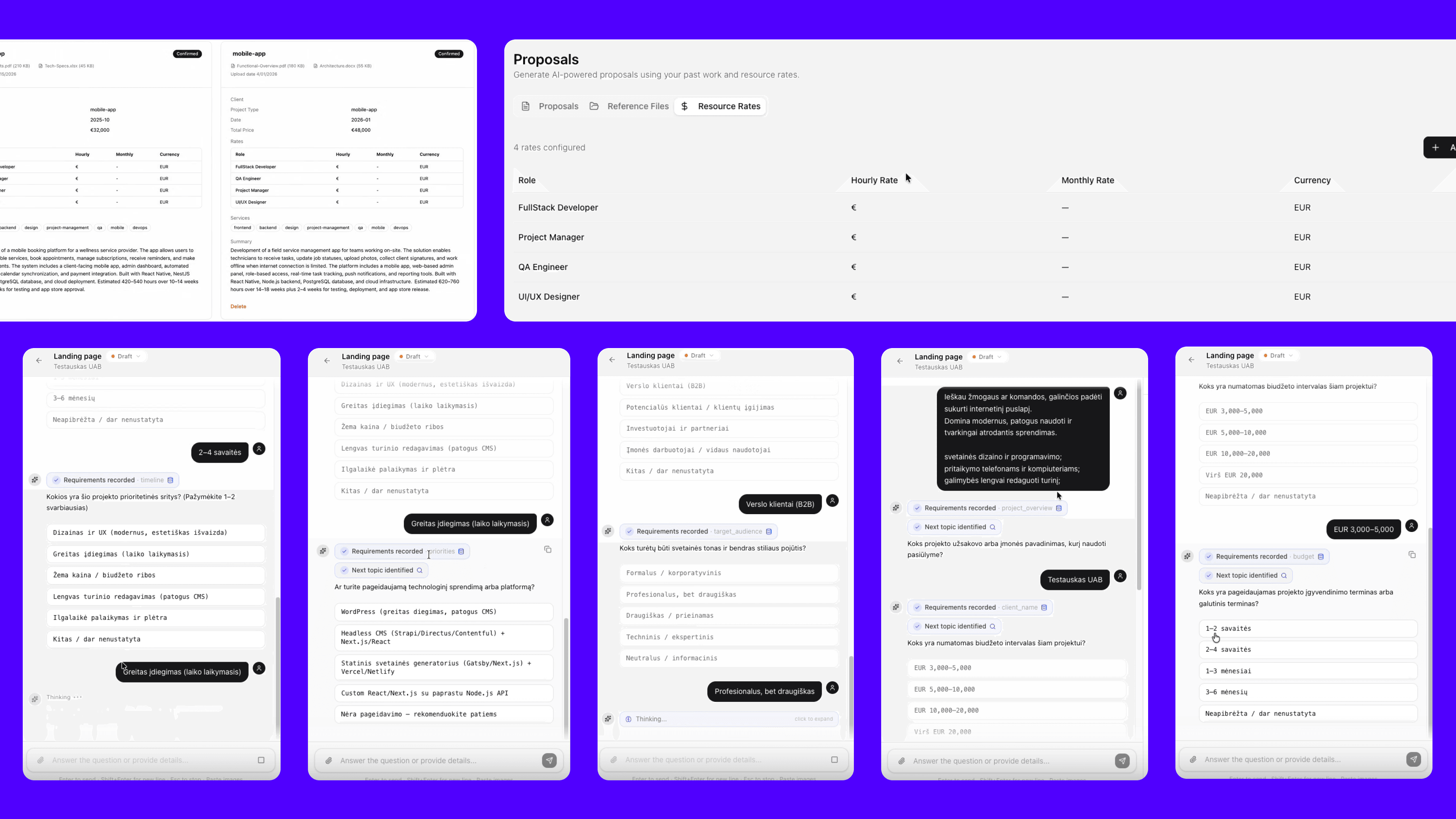
Resource Rates. Our team's rates - Full-Stack Developer, Project Manager, QA Engineer, UI/UX Designer - are configured directly in the system. Every pricing calculation in every proposal pulls from these rates automatically. No manual math, no spreadsheet hunting, numbers are always right.
Reference Files. We uploaded our previous proposals as training examples - real documents from real projects that had already won clients. The AI learned our structure, section order, tone, and level of detail from those. It doesn't guess what a good Mygom proposal looks like; it knows.
The workflow is built to be fast without sacrificing quality. You pick the document type (Commercial Proposal, Technical Specification, or Public Procurement Spec), and the tool adjusts its structure accordingly. You enter the basics - project name, client, type - in about thirty seconds, then paste in your context: meeting notes, a client email, a brief. Rather than generating immediately and guessing at the gaps, the tool asks clarifying questions first - scope, hosting requirements, integrations - with quick-reply options so answering takes seconds. Then it generates the document section by section, giving each part full attention, so the result is structured and complete rather than a wall of text that needs reformatting.
Key features
- Trained on Context: Learns from real Mygom proposals, not general knowledge.
- Accurate Pricing: Pulls role rates automatically - no manual math or spreadsheets.
- Three Document Types: Commercial proposals, technical specifications, and public procurement specs.
- Clarifying Questions: Asks what it needs before writing, with quick-reply options.
- Section-by-Section Generation: Each section completed in full for a clean, structured output.
- Consistent Output: Same accuracy, structure, and tone no matter who runs it.
- Context Input: Turns raw notes, emails, and briefs into a finished draft.
Tech Stack
Next.js
Nest.js
PostgreSQL
TypeScript
Tailwind
OpenAI
Results
The proposal tool changed where our team spends its time. What used to mean switching between four or five things - meeting notes, an old proposal to borrow structure from, a pricing spreadsheet, a blank document - is now a conversation: you give the AI context, it asks what it needs, and it writes. Proposal preparation dropped from 3-4 hours to 30-60 minutes.
Just as important, every proposal that goes out is consistent. The pricing is accurate, the structure is right, the tone is ours - regardless of who's handling it. The team spends less time on documents and more time on clients, which is exactly where that time should go.
The logic extends well beyond proposals. Any business producing repeatable documents - proposals, specifications, audits, reports - faces the same gap between a conversation and a finished document, and that gap costs time, momentum, and sometimes deals. A custom AI tool trained on your own context will outperform a generic one every time, not just on speed but on accuracy and consistency.
70-85%
Reduction in proposal writing time
3 in 1
Document types from a single tool
100%
Consistent pricing and structure