EdTech
Building a Modern Platform for Language Education
Client Overview
Our client is a language education organization that helps bilingual families maintain their connection to the Lithuanian language and culture. They work with children, parents, and teachers across several countries, offering live online lessons and self-paced learning resources.
Their goal is to make language learning accessible and practical for Lithuanian families living abroad. As their community grew, they needed a more consistent and easier-to-manage digital experience for both users and administrators.
The Challenge
The organization’s platform had evolved over time, and the overall system had become difficult to manage. Key workflows were spread across multiple tools, which created extra complexity for parents, teachers, and administrators.
Parents had no simple way to manage multiple children’s schedules, progress, and class information in one place. Teachers handled lesson materials, attendance, and communication across separate tools. Administrators relied on manual processes for scheduling, meeting setup, and day-to-day coordination, which created extra admin work.
The main issues were:
- User and course management spread across multiple tools
- No centralized parent view for families with multiple children
- Manual scheduling and meeting link creation
- Inconsistent communication flows across user roles
- A public website that was difficult to update and did not support multilingual content well
- Missing integrations with tools such as Stripe, Calendly, and Zoom
As the organization grew, these limitations made the system harder to maintain and slowed down daily operations.
Our Solution
We redesigned the platform as one connected system for parents, students, teachers, and administrators.
The project included rebuilding the public website, redesigning the main application, and integrating the tools needed for scheduling, payments, communication, and live classes. Rather than solving each issue separately, we redesigned the website, the core application, and the supporting integrations into a single, connected system. The goal was to reduce manual work, simplify daily operations, and make the platform easier to use for all user types.
The platform was designed and delivered over six months by a team of three: a developer, a QA engineer, and a project manager.
We built the public website using Next.js, PayloadCMS, and MongoDB. It gives the organization a simpler way to manage pages, images, translations, announcements, and lesson information without relying on developers for every content update. The website was also built with multilingual support in mind, so content can be updated more easily across languages.
For the main application, we used Next.js, PostgreSQL, NestJS, and ShadCN UI. It brings together workflows previously spread across multiple tools, including enrollment, scheduling, payments, communication, and content access.
The platform supports three main user groups:
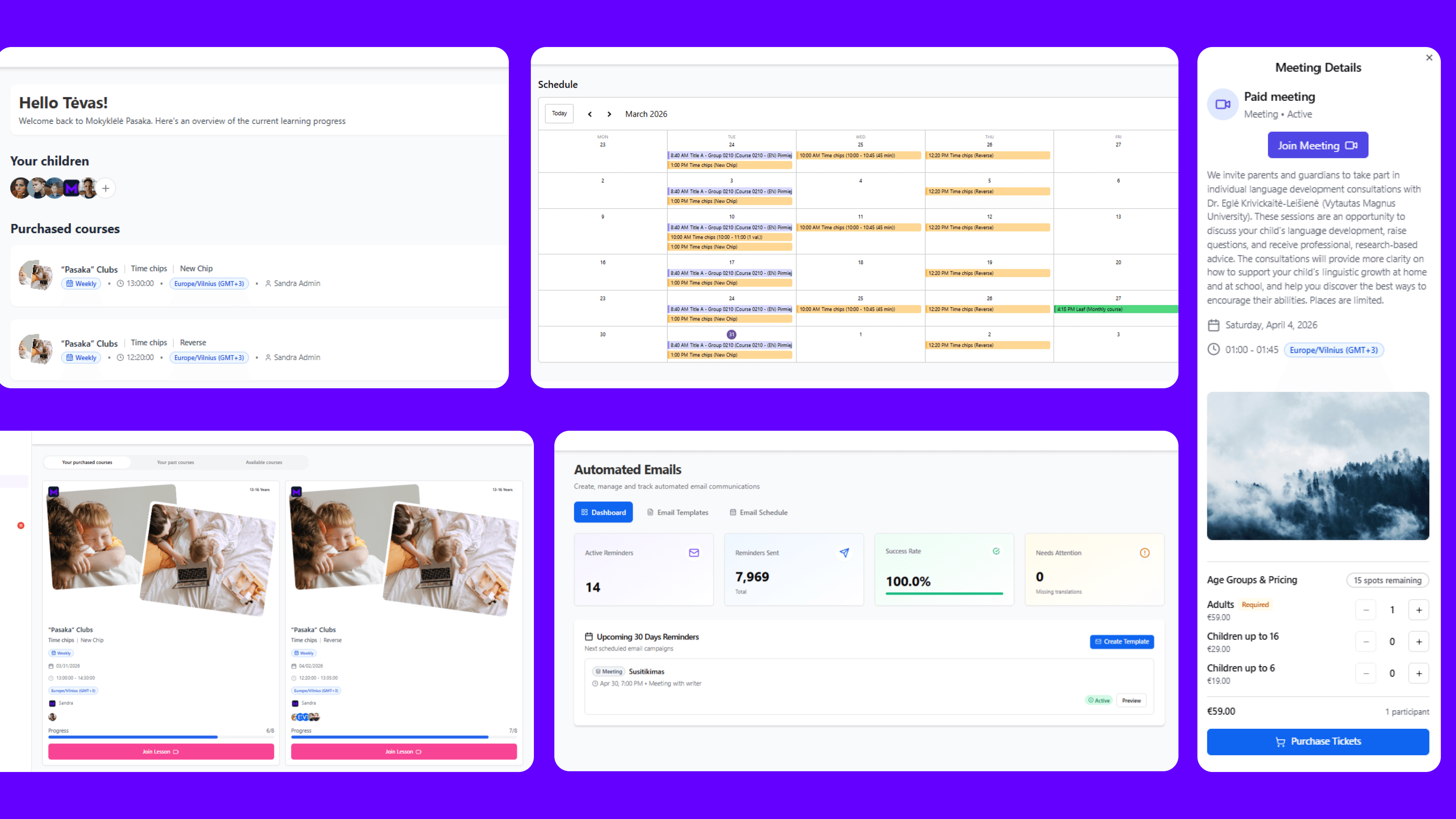
- Parents and students can manage profiles, view schedules, access homework, track progress, and handle payments, including across multiple children.
- Teachers can manage lesson materials, attendance, communication, and class scheduling in one place.
- Administrators can manage users, courses, finances, website content, and system settings from a single dashboard.
To support these workflows, we also built and integrated several key features. We connected Calendly for teacher availability and student bookings, and built a custom in-app calendar so users can see their schedules without leaving the platform. Meeting links are created automatically, and scheduling works across time zones.
We also introduced a messaging system that clearly ties communication to a specific child, which is especially useful for families with more than one student enrolled. Parents and students can sync schedules with Google Calendar or Apple Calendar, or export them to Outlook.
In addition, we integrated Stripe, Zoom / Google Meet, and maintained the existing Salesforce connection so operational data could continue to move between systems without disrupting existing processes.
Tech Stack
Next.js
ShadCN UI
NestJS
PostgreSQL
MongoDB
PayloadCMS
Results
The new system gave the organization a more consistent way to manage both its public website and its day-to-day operations.
Parents can now see schedules, make payments, and track each child’s progress in one place. Teachers have a clearer workflow for managing class materials, attendance, and communication. Administrators can manage content, users, courses, and finances through a single system, eliminating the need for separate tools and manual steps.
The public website is now easier to update and maintain, with multilingual content managed directly through the CMS. This makes it easier for the organization to keep information current and accessible for families in different countries.
Overall, the platform reduced complexity for both users and administrators. Instead of relying on disconnected tools, the organization now has a single system that supports its core workflows and is easier to manage as the program grows.