AI Collaboration Between Sales and Engineering
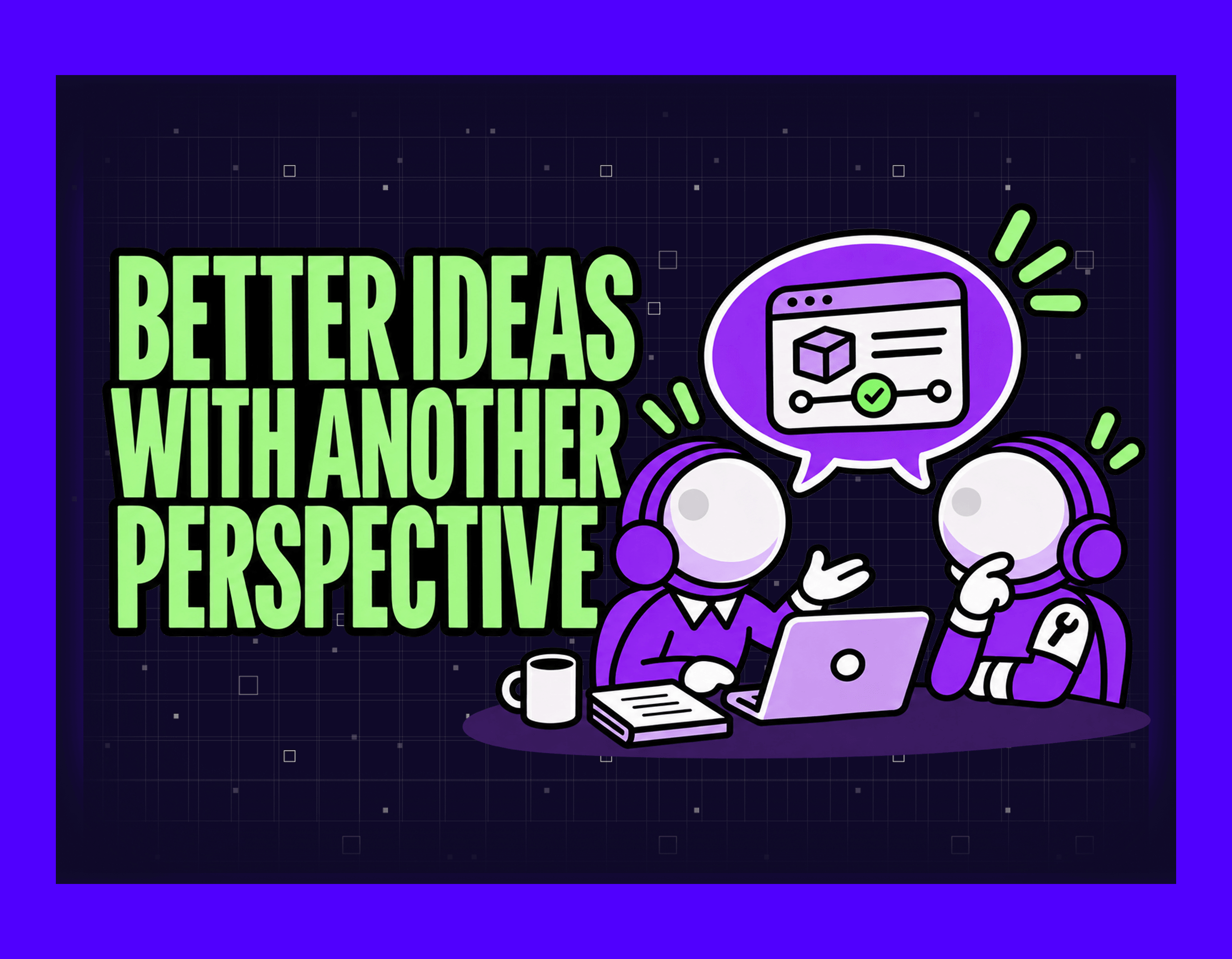
Imagine a salesperson bringing back a customer's request for a portal to replace calls about order updates. The salesperson sees a useful service and a reason for the customer to choose their company again. An engineer wants to know where the updates will come from and what happens when an order runs late. AI collaboration can help these colleagues explore each other's perspective before they meet to develop the idea together.
Each person brings useful experience, but their first proposal may reflect their own work more than the customer's whole problem. Sales can explain why someone would want the service. Engineering can work through what it would take to build. Generative artificial intelligence can suggest questions from the less familiar discipline while the idea is still open to change.
AI collaboration can broaden the perspective behind an idea
Fabrizio Dell’Acqua and his co-authors explored this effect in their 2025 NBER working paper, “The Cybernetic Teammate” (opens in new tab). They ran a field experiment at Procter & Gamble between May and July 2024. The main analysis covered 776 randomly assigned employees from commercial and research and development functions in Europe and the Americas. This was a study inside a large consumer goods company, rather than a survey of Lithuanian businesses.
Participants used GPT-4-based tools in the AI conditions and tackled early product innovation problems relevant to their business units. This was product ideation: developing initial proposals rather than building or launching finished products. Some worked individually; others worked in pairs comprising a commercial employee and an R&D employee. Both arrangements included conditions with and without artificial intelligence. Experts evaluated the resulting proposals without knowing who had written them or which condition they belonged to.
The finding that matters here concerns the content of those proposals. Without the tool, commercial employees tended towards commercial ideas, while R&D employees tended towards technical ones. With it, the difference narrowed. Employees from both backgrounds produced more balanced proposals, making their professional function less predictive of the approach they suggested.
That does not establish that the participants acquired their colleagues' qualifications or launched commercially successful products. In the full working paper (opens in new tab), the authors leave open whether assistance produces lasting expertise. The useful finding is narrower: at the idea stage, people could reach beyond the perspective associated with their own role.
The portal request starts with a customer waiting
Return to the imagined self-service portal. The first version of the idea sounds reasonable: customers will sign in and see their order status. Sales can explain the attraction. Customers would no longer need to contact an account manager for every update. Yet that description still leaves the customer's actual information need unresolved.
Before talking to engineering, the salesperson could ask the tool for possible explanations behind the request and their implications for the service. Perhaps the customer needs a confirmed delivery date. Perhaps they want notice of a change while they can still adjust their own schedule. These are hypotheses to check with the customer, but each points towards a different design.
A label saying “order in progress” offers little help to someone scheduling installers around a delivery. A reliable expected date could be more useful than a detailed list of processing stages. That commercial observation changes the technical question as well. The team needs to consider which information would help the customer make a decision.
Sales could now bring a clearer need into the discussion: the customer wants to plan work around the order's arrival. There is also a specific question for engineering: does the company have a delivery estimate reliable enough to support that promise? The conversation can address customer value and feasibility together, before anyone commits to a feature list.
A technical constraint can suggest a better service
The engineer could prepare for the same conversation by starting with the available information. Suppose an order's status changes only when an employee confirms an update in the company's system. An automatic portal could then display old information even when the website works correctly. The customer would receive an answer without knowing whether they could rely on it.
Here, AI collaboration could help the engineer explore service options with the customer's needs in mind. One option to explore would show when someone last confirmed the delivery date and let the customer request a fresh check. An employee would receive that request against the relevant order. The team would still need to establish whether the process is workable and who would respond.
That option changes the idea rather than simply identifying a risk. The portal could help customers understand when information is dependable and how to get a better answer. Sales would assess whether this service addresses the customer's need. Engineering would check how to show the confirmation time and route the request to the right person.
The technical limitation has now prompted a different service design. The team has an alternative to abandoning the idea or promising more than its data can support. Both colleagues can contribute before choosing what to build. The additional perspective matters because it changes the proposed service, not merely the wording of its description.
A fuller proposal gives colleagues more to discuss
After that preparation, the proposal might read: the portal will help customers plan work using confirmed delivery information. It will show when an employee last checked the date and allow customers to request clarification. The team must still verify the information's reliability and agree who will respond. This is a proposed design for discussion, with important questions still visible.
The description holds the customer's purpose and an implementation condition together. For interdisciplinary teams, that gives colleagues a proposal they can examine from both perspectives. Colleagues can now challenge the substance. Perhaps a delay notification would be more useful, or a different channel would make clarification easier. They can compare those options against a shared customer problem rather than debate whether a portal sounds attractive.
Our article about the proposal-writing tool we built (opens in new tab) describes a related workflow choice. The tool asks clarifying questions before generating the document. That example shows how a workflow can make room for questions before a finished draft. The evidence about more balanced professional perspectives comes from the P&G experiment.
When an additional solution is unnecessary
The next step depends on what currently prevents the team from developing a useful proposal.
- If colleagues already define the customer's need and the delivery conditions together, start with their discussion. You may not need a separate tool or training programme for this task.
- If the company lacks reliable delivery information, first agree who will check and update it. A detailed proposal cannot supply missing facts, and artificial intelligence cannot confirm them on an employee's behalf.
Where to start
Choose an idea you will soon discuss with a colleague from another discipline. Try AI collaboration by asking the tool to suggest an alternative that connects the customer's benefit with the conditions needed to deliver it. Compare the versions with your colleague to decide which better addresses the customer's problem and what still needs checking. A concrete improvement to the idea gives you something useful to judge when using AI for innovation.
At MYGOM, our practical AI training for teams (opens in new tab) helps people try tools and apply them to a work task agreed in advance. If the task recurs, a custom solution may also be worth discussing, with its scope based on a tested need. The starting question is what an additional perspective would help your team decide.
To discuss how artificial intelligence could fit your team's work, Contact us (opens in new tab).