How AI Automation Transforms Farm Operations the Right Way
You bought the software. You added the sensors. And someone on the team still opens a spreadsheet before sunrise to work out what's actually happening in the field.
That gap - between the tools you own and the decisions you can make - is where most precision agriculture AI projects quietly die. Not because the technology doesn't work. Because nobody fixed the workflow underneath it. Done right, AI automation closes that gap, but only when it's built around how the farm actually runs.
The prize is real. McKinsey (opens in new tab) estimates AI could deliver around $100 billion in value at the farm level and $150 billion at the enterprise level across agriculture. The agriculture software market is growing to match - farm management software is projected to reach roughly $10.58 billion by 2030. But the same research keeps surfacing one uncomfortable pattern: farmers are demanding clearer ROI, lower implementation cost, and technology that's easier to set up. Most tools don't clear that bar.
At Mygom, we build AI automation around workflows, data pipelines, and operational visibility - not around demos. Here's how to tell which farm processes are actually worth automating, and how to build so the result survives daily field pressure instead of dying in a pilot.

Why precision agriculture AI projects stall
Stalled projects look busy. Field notes get entered twice. Machine logs get checked after the problem already spread. Inventory counts land late, so buyers miss timing and pay more. Compliance packets get rebuilt by hand at month end.
You feel it in the daily lag. Irrigation calls go out late. Input decisions trail field conditions. A machine sits idle while someone digs through emails, texts, and a portal to find one number. Managers end up acting on yesterday's reality, not this morning's.
The root cause is rarely a missing app. It's a broken flow of events, decisions, and ownership. Sensors, ERP records, telematics, spreadsheets, and email approvals all move on different clocks. That fragmentation blocks timely action far more than any shortage of dashboards.
So when an agro AI project fails, the model usually wasn't the problem. The workflow beneath it was. If field data arrives late, labels are inconsistent, or no one owns the handoff, the output can't drive a decision. Precision agriculture AI has to automate intake, routing, alerts, and decision support - not just prediction.
What it is not: a robot-first strategy, a black box with no operating logic, or a dashboard that still depends on someone manually exporting data every morning.
The quick fixes that don't fix it
The usual moves feel productive and change nothing. Buy another standalone tool. Ask staff to update the system more often. Add more reports and hope visibility appears. In practice that just creates more admin work and more stale data.
The real fix is more basic. Map your event sources, decision points, and handoffs. Define data-quality rules and ownership. Only then automate. Skip the workflow design and you're automating chaos at higher speed.
Where AI automation actually pays off
Good farm automation doesn't start by ripping systems out. It starts by connecting them - keep the current stack, add API-first ingestion, then build pipelines that clean, map, and route data into one operational layer.
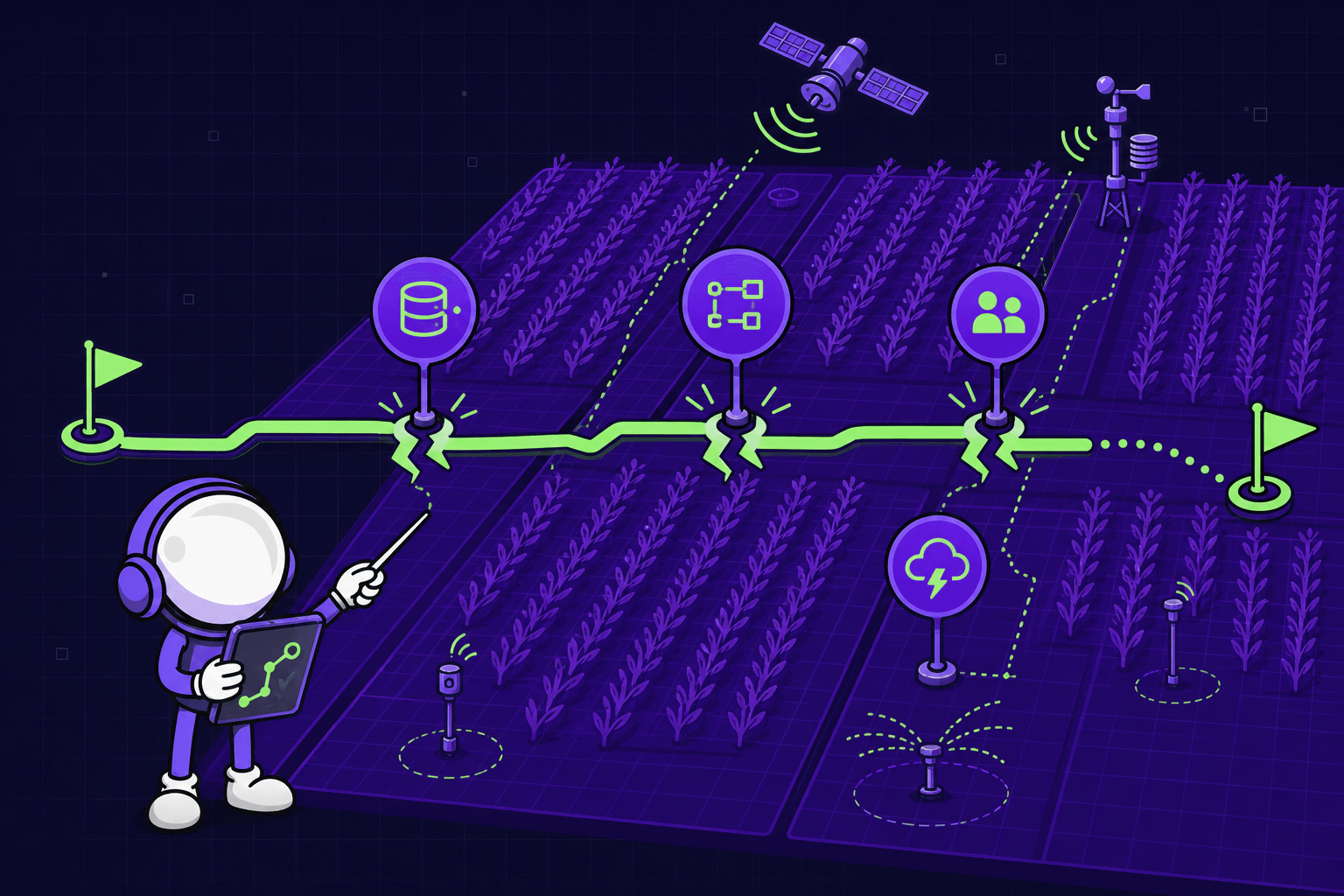
Crop monitoring with exception-based alerts. Most teams don't need another map; they need fewer blind spots. Combine sensor feeds, satellite or drone imagery, weather, and historical field records into one normalized field model, then alert only on real anomalies - say, soil moisture drops below range, no meaningful rain in the forecast, and that field already missed its last irrigation window. Now the team acts on exceptions instead of scanning every block by hand.
Inventory across inputs and outputs. Inventory breaks when every team updates a different record. Sync stock across seed, fertilizer, chemicals, packaging, and harvested output by pulling from purchase orders, warehouse scans, field usage logs, and loadout records into one table. That table feeds reorder rules and variance alerts, so an overspend on a spray plan gets flagged before the next block starts, not at month end.
Predictive equipment maintenance. Breakdowns rarely arrive as a surprise; the clues sit in another system. Ingest telematics, runtime, fault codes, and service history. Standardize the IDs and timestamps, then score failure risk and open a maintenance task before a breakdown blocks planting or harvest.
Compliance without the month-end scramble. Most farm systems already retain the records for years. The problem isn't storage, it's structure. Capture operator inputs, machine records, and treatment data in a structured form from the start, and let it auto-populate the regulatory forms and audit trail.
What the returns actually look like
The gains don't come from magic. They come from work that stops falling between systems - fewer manual reconciliations, faster field decisions, less waste, less downtime, lighter admin load.
We know the pattern because we've done it on ourselves. Invoicing used to be split across tools that didn't talk to each other, and it got heavier as we grew. So we built our own system - AI Invoice Automation Platform (opens in new tab) - first for us, then for clients. The result: 40% faster processing, 30% lower spend on the tools it replaced, and 10x the volume handled with no extra headcount. We did the same for our sales team with a tool that writes our proposals (opens in new tab), cutting proposal time from half a day to under an hour.
We've seen the same pattern outside agriculture. For a steel manufacturer (opens in new tab), production managers were compiling status by hand across separate systems before every shift - the same siloed-tools, reactive-decision bottleneck farm ops managers hit every morning. We rebuilt it around the actual workflow and gave each production manager back about 3 hours a day. Different industry, identical problem.
This is also why we'd rather start with an honest look at your operation than sell you a platform. As the McKinsey data (opens in new tab) shows, the projects that fail are the ones that skip the ROI question. The ones that work pick a painful workflow and prove the number first.
Build it the operational way
The farms that get value from precision agriculture AI start with an audit, not a wish list. Map your agriculture workflow - every repeated manual task, every system in the chain, every handoff, and every place where late or missing data slows a decision. That exposes the real bottleneck and shows where AI automation will hold up in the field.
Then narrow the scope. Pick one workflow that hurts every week and can show value fast - crop alerts, input inventory, maintenance planning, or compliance reporting. A focused first release lets your team prove adoption and fix edge cases before you scale.
And keep it alive after launch. Assign process owners, add data-quality checks, review the numbers weekly, update the SOPs when the workflow changes. Without that, even a strong build drifts back to spreadsheets and side messages.
If you're spending more time on data than on decisions, that's the signal.
Let's start with the workflow map (opens in new tab) and build from there.