Vehicle Damage Inspection: How AI Counts Hail Dents
A vehicle damage inspection is the work of an assessor at an insurer or a repair shop. The assessor looks over a damaged car and writes the report that sets the repair figure. After a hailstorm a lot of that work arrives at once, because hail does not hit one car. We built a system that counts hail damage from a phone video. Below is how it works, what the model does not do, and what turned out to be hard.
The inspection starts with counting. Someone walks around the car and marks every dent on the hood, the roof and both sides. That count sets the repair estimate. On a badly hit car it also decides whether the vehicle is written off.
The counting is slow for reasons that have nothing to do with skill. Hail leaves shallow dents that overlap each other. They show up only at certain angles to the light. So the person keeps moving around the car and keeps looking.
What a vehicle damage inspection looks like now
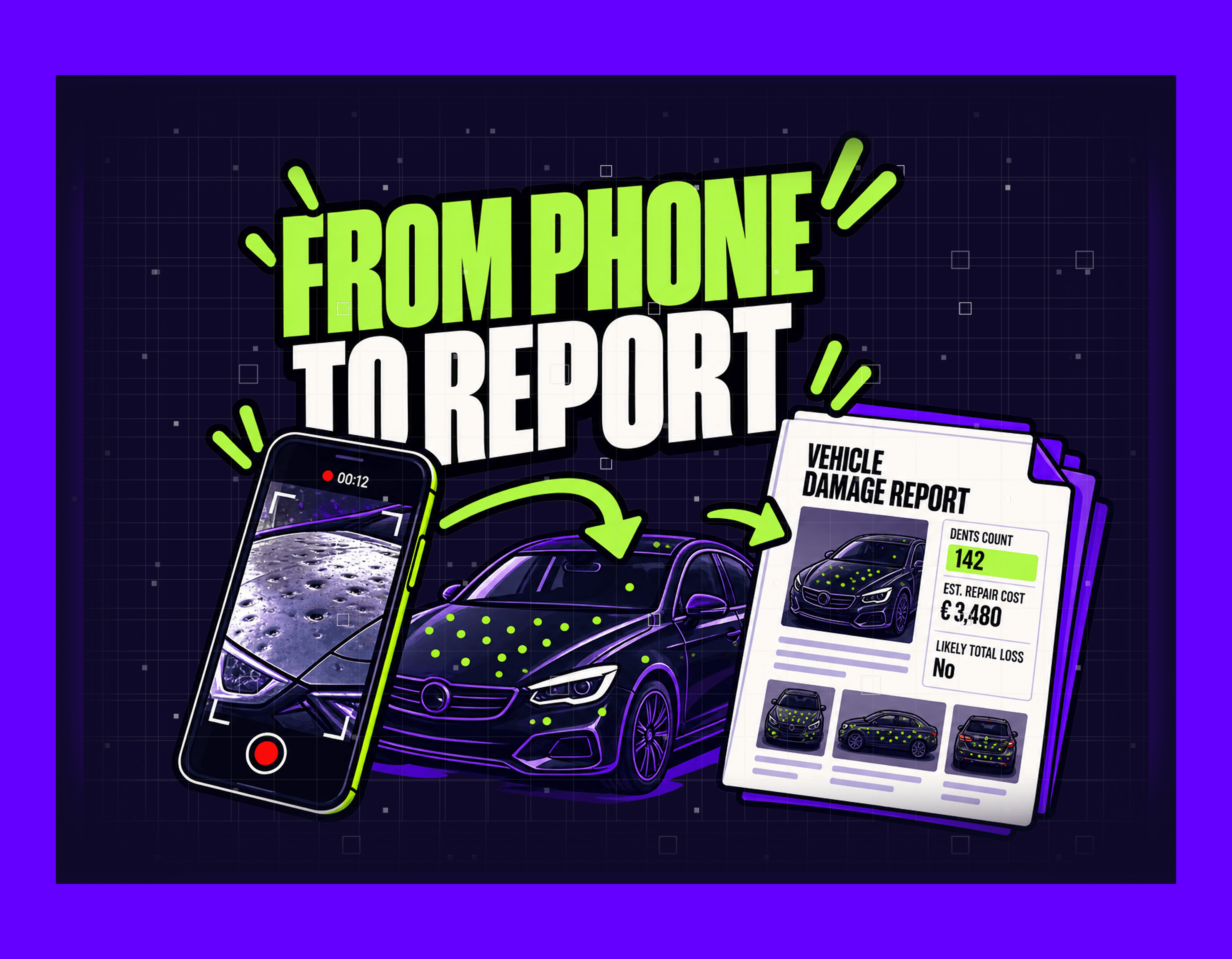
A vehicle damage inspection now begins on a phone. The app asks for short portrait videos: the hood, both sides, and the roof from each side. Every shot has an example on screen. The person sees what a usable recording looks like before filming it. Photos can be added when something needs context. Uploading starts on its own as soon as the footage exists.
That last part matters more than it sounds. The filming happens at the car, while uploading used to depend on someone remembering it once they were back. Now the report starts while the person is still in the yard.
What the model does, and what it does not
Once the video lands, a workflow takes over without anyone pressing anything. It reformats the recording, runs dent detection through Roboflow (opens in new tab), and infers the damage. The result is a PDF holding the dent counts and the damage read. It goes to storage and is available in minutes.
The report does more than count. It assesses what the repair needs and flags the cars that are likely total losses. That second output carries the most weight, because it is the one nobody wants to get wrong.
Every step is logged: the vehicle, the upload time, the report status and the weather at the time. Weather is in that list for a reason. A shallow dent shows only in certain light, so the weather is recorded next to the dent count.
The detection models were fine-tuned on footage the system had already processed. Each batch of vehicles made the next batch easier to read.
A vehicle damage inspection does not decide the payout. It counts and it reports, and a person decides what the count means for this car and this policy. That line is where a person still decides (opens in new tab).
What turned out to be hard
The model was not the hard part. Getting a usable recording from someone standing in a yard was.
That is why the app leads the shot instead of leaving it open. Each angle has an example and the sequence is fixed. A recording that misses the roof cannot be rescued by a better model afterwards. This holds only while the filming is done by someone you can instruct, not by a customer.
The second hard part was knowing whether any of it worked. A dent count is only worth having if it holds across cars, light and weather. That is why the conditions are logged with every record. The pilot ran on more than 600 vehicles before the numbers below were counted.
What more than 500 vehicles showed
More than 500 vehicles have gone through the system. Over 80% of the reports were produced in under ten minutes. The vehicle damage inspection runs end to end without a person in the middle, from upload to stored report.
Those are numbers from one system we built (opens in new tab), not a forecast for another company.
Ten minutes is the figure worth holding on to. It is short enough that the report exists before the car leaves.
Frequently asked questions
Does this work on other damage, such as after a crash? Not straight away. The models were fine-tuned for hail. Crash damage looks different: a few large areas rather than hundreds of identical dents. Another damage type is another training job.
Who owns the training data? The client does. Their own footage is what refined their models, and that is the part no supplier can bring with them.
Does it need special equipment? No. A phone and the app are enough, and the recording follows the examples on screen.
Can photos do the same job? Photos help where something needs context. The sequence itself is built on video, because a moving camera catches shallow dents that one frame misses.
What is left for a person? The judgement. The system produces the number, and what it means for one car and one policy stays with the assessor.
Where to start
Open the last ten reports your company produced by looking at something, rather than by reading a document. Mark the ones where two of your people would have written the same numbers.
The unmarked ones are the answer. A short list means the judgement is consistent and the time goes into writing, which is a smaller job. When the list is long, the number depends on who did the walk-around. A model can take that part over.
From there we take over. We look at what gets recorded today and whether it fits into a fixed sequence. Then we work out how many cases a month it takes for a trained model to pay for itself.
Get in touch (opens in new tab) if this work in your company is done by a person with a phone. If the volume is too low for it to pay off, we will say so in the first conversation.