Why Companies Delay AI Adoption 2026: 8 Doubts
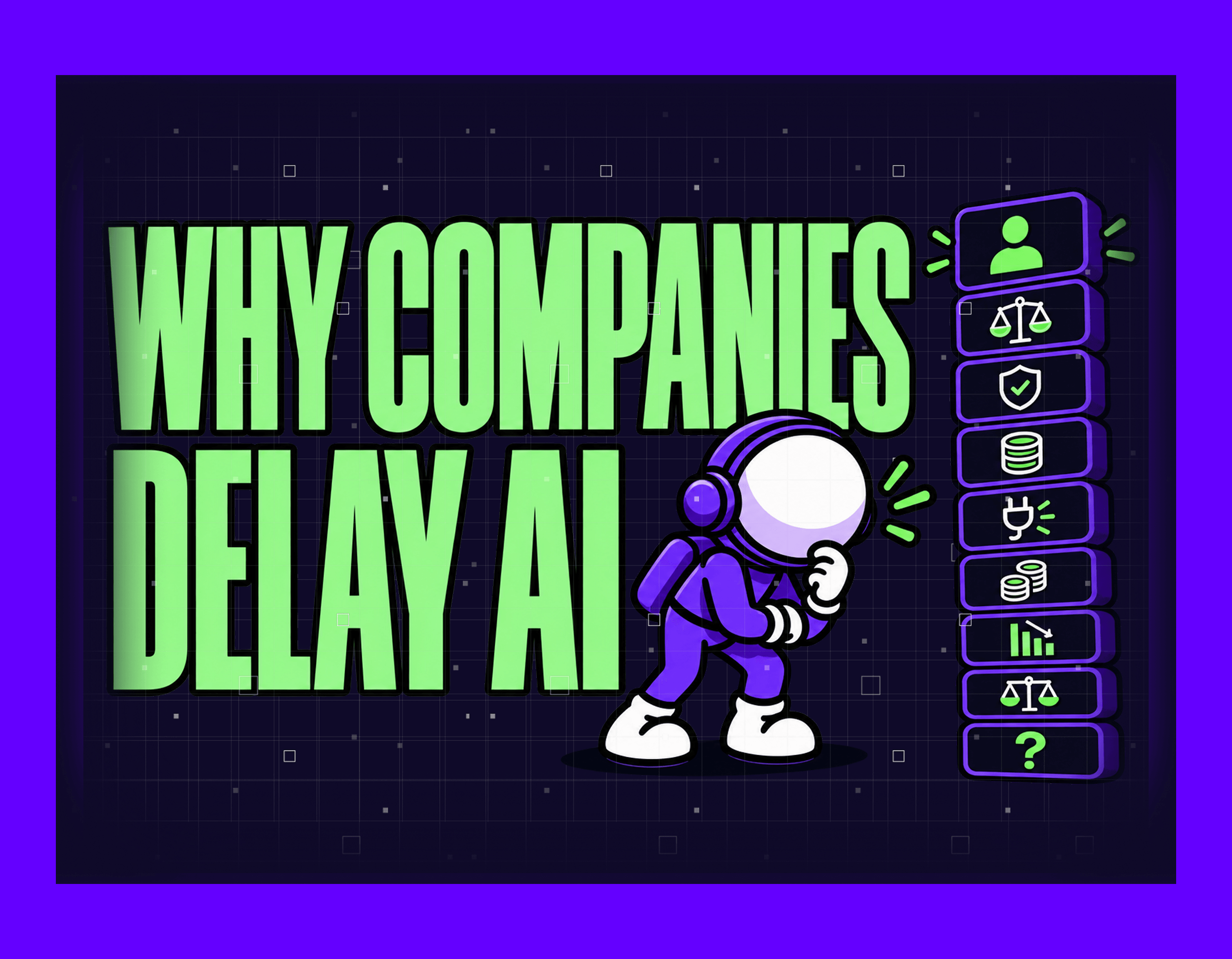
Companies delay AI adoption for eight reasons, and the one named most often is a shortage of relevant expertise. Price sits sixth on that list. Eurostat compiled the ranking. Below we go through the main ones: what each means in daily work and how we answer it.
Every doubt on that list is reasonable. The decision is made once, it changes work that already runs every day, and the promise cannot be tested in advance. Few companies stop at a single doubt, and most carry several at once.
What stops AI adoption in companies?
Eight doubts stop it, and they are ranked here by how often companies name them. Eurostat asked only those enterprises that had considered artificial intelligence and still did not adopt it, and they make up 14.2% of non-users. The figures were collected in December 2025 (opens in new tab), and each enterprise could name as many doubts as applied to it.
- Lack of relevant expertise, 70.3%
- Lack of clarity about legal consequences, 53.6%
- Data protection and privacy concerns, 52.7%
- Availability or quality of data, 43.5%
- Incompatibility with existing systems, 41.6%
- Costs seem too high, 38.4%
- Ethical considerations, 24.6%
- Not useful for the enterprise, 17.8%
Lack of expertise comes first everywhere: among small companies, among large ones, and across every sector. Small enterprises, meaning 10 to 49 employees, are also the least likely to have considered the subject at all, at 12.7%.
The fourth doubt is usually read backwards. Messy data does not stop a project, because the system reads the document in the shape it arrived. An undocumented process does stop one: where two people describe the same step differently, AI automation will record both versions faster.
Lithuania is moving quickly. In 2025, 21.3% of Lithuanian enterprises used at least one such technology, and among small ones 18.1%. That share rose 12.5 percentage points in a year, one of the largest increases in the EU.
Why does lack of expertise come first?
Expertise sounds to most people like a hiring requirement, somebody who understands models. No such person is on the payroll and none will appear soon, so the whole question gets postponed.
An AI automation project needs something else: one person who can explain how the work is done today. The same person decides what to do with the odd cases. That person already works at the company, because they already do the job. Models, data and connections belong to whoever builds the system.
If an earlier attempt failed to stick, look at whether it had an owner. A tool bought without a named person and without a written description of the work is abandoned within weeks.
Hiring is also the slowest route. PwC surveyed 280 Baltic executives in 2026, 77 of them in Lithuania, and only 28% said their company can attract highly skilled AI specialists (opens in new tab). While that hire is awaited, the process that started all of this stays exactly as it was.
What do the law and data protection require in 2026?
Less than most people assume, and the requirements reach only some systems.
Transparency. Article 50 of the EU AI Act applies from 2 August 2026 (opens in new tab). It says the provider of a system has to design it so that a person immediately understands they are dealing with an AI system. Separate duties fall on whoever deploys one. Disclosure is required for synthetic image or audio and for emotion recognition. It also covers published text on matters of public interest that no person reviewed first.
All of those duties concern systems that talk to people. A system that reads an invoice, matches a payment or fills in a report sends the customer nothing. The same holds when it pulls a specification out of a tender document. Disclosure arrives once the system starts writing to people on your behalf.
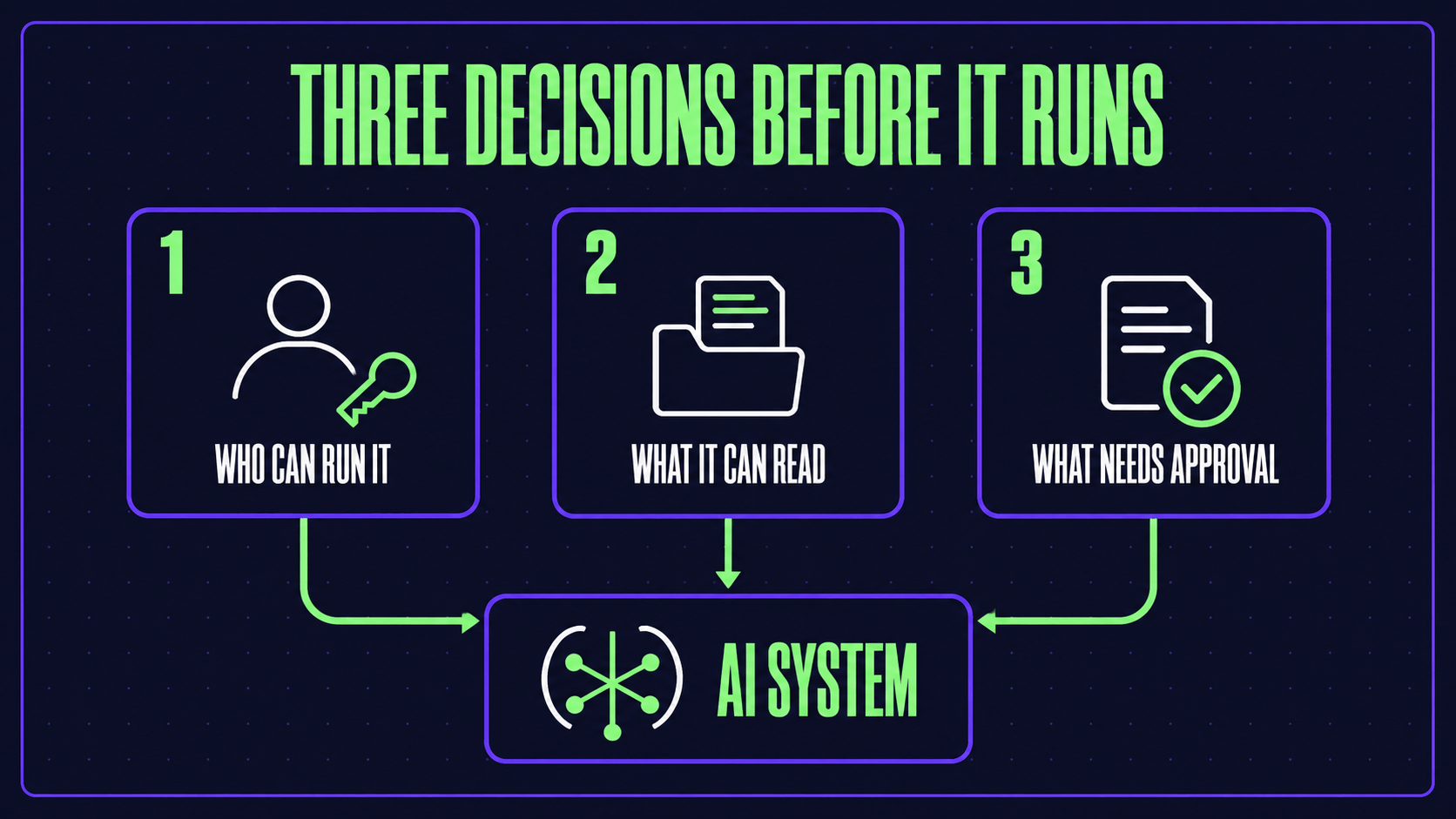
Access. What the system will see is decided by the company. These are three separate decisions, and all three are made before go-live.
- First, somebody decides who can run the system. Access rights are kept in one place rather than next to each tool, because otherwise nobody knows who is allowed what.
- Second, the company agrees what the system may read. Automation that handles the invoice inbox has no business in the salary folder, and that scope is written down once.
- Third, the team sets which actions wait for human approval. With every answer the system states how sure it is. Anything below the threshold you set reaches a named person together with the reason.
The third decision is the one that usually never gets made. Without it, a system that went wrong and did not notice passes its mistake on as a correct answer. People stop checking such a system quickly, and from that moment nobody catches the errors.
Few companies have written any of this down. In the same PwC survey, 36% of Lithuanian executives reported formal processes for managing AI risk. A clear action plan was reported by 43%.
When does price become the question?
Once the first three doubts are cleared. They close the AI adoption conversation before any numbers: a company that cannot name the person to run the project never reaches the quote.
What those numbers buy is clearest from finished projects. In our own invoice system, processing time came down 40% and one person handles ten times more invoices. Automatic matching against bank payments runs at 95% accuracy.
For a sheet metal manufacturer we rebuilt how custom orders arrive and get priced (opens in new tab), and the admin work around each order halved. A steel manufacturer asked us for material tracking (opens in new tab): output rose 15%, picking and dispatch got 35% faster, and the production manager got three hours of the day back.
Each of those started with an audit of fixed length, and the fee for it is deducted from the implementation price. The fifth doubt is settled at the same time. Existing programs do not have to be replaced, because we connect to what already runs, and the route depends on the program.
Whether the saving is real shows in one number, chosen before the work and checked after it. Hours spent, cases handled per person, error rate and software spend all work. Measuring the starting point is covered in how to check whether automation will pay off (opens in new tab).
When is a project worth postponing?
There are two such cases, and neither needs an audit to spot.
Nobody can give the project a few hours a week. Those hours are needed once a week, not every day. Without them the work stalls right after the audit, and the audit has already been paid for.
The eighth doubt is sometimes right. 17.8% of enterprises said AI is not useful for them, and some of them are correct. Where the same job repeats rarely, a system costs more than it saves, and one conversation is enough to see that.
Where to start
Go back to the list of eight and see which ones are yours. That is where the whole AI adoption effort begins.
From there the work is ours. During the audit we measure whether a system would change anything. We say so when an agreed routine is enough on its own. What is needed, we build and connect to the tools the company already runs.
Get in touch (opens in new tab) if one of those doubts is holding your company back, and we will help you work out where to start.