AI in a Manufacturing Company: Quotes and Lead Times
In short: pricing a custom order in a manufacturing company
Where the time goes | Pricing a custom order is mostly search rather than calculation: finding a comparable job, checking material prices that have moved, checking whether the shop has room. |
Why hiring does not fix it | Engineering technicians are among the hardest roles to fill in Lithuania, so the quoting queue cannot be shortened by adding a person to it. |
Order process | At a sheet metal products company the order process became two times faster after we reworked intake and pricing. |
What it changed for the team | The same team began taking on five times as many custom enquiries, and administrative work around each order dropped by half. |
Where a price comes from | From earlier similar jobs: their cost, their hours, their scrap. There is nothing to look a price up in. |
What stays with a person | The final number. The system drafts a price and shows its working, and the person signs what goes out. |
The three figures above come from one project of ours. Read them as a direction rather than as a forecast for your company.
In a manufacturing company, AI pays off first at the desk where an enquiry turns into a price. It reaches the shop floor much later. Quoting a custom order is the work of reading what the client wants, finding out what a similar job cost last time, checking materials and shop load, and only then writing a number. This article covers why that takes days, what an AI system actually does there, and when none of it is worth building.
We have written before about what happens when a whole process rests on one person (opens in new tab). In a manufacturing company that person is usually whoever knows how to price a job. This article stays with that one task and asks which part of it can be handed to a system at all.
Why does a custom quote take days?
Calculating the price is quick. Everything that happens before the calculation is what takes the time.
The enquiry arrives by email with a drawing attached, and half the conditions are written in a sentence in the middle of the message. Somebody has to work out what the part actually is. Then find whether something similar was made before, what it really cost and how long it really took. After that, check material prices, which have moved since last time. Finally, look at whether the shop has any room that week.
Only after all of that does one number and one date get written down.
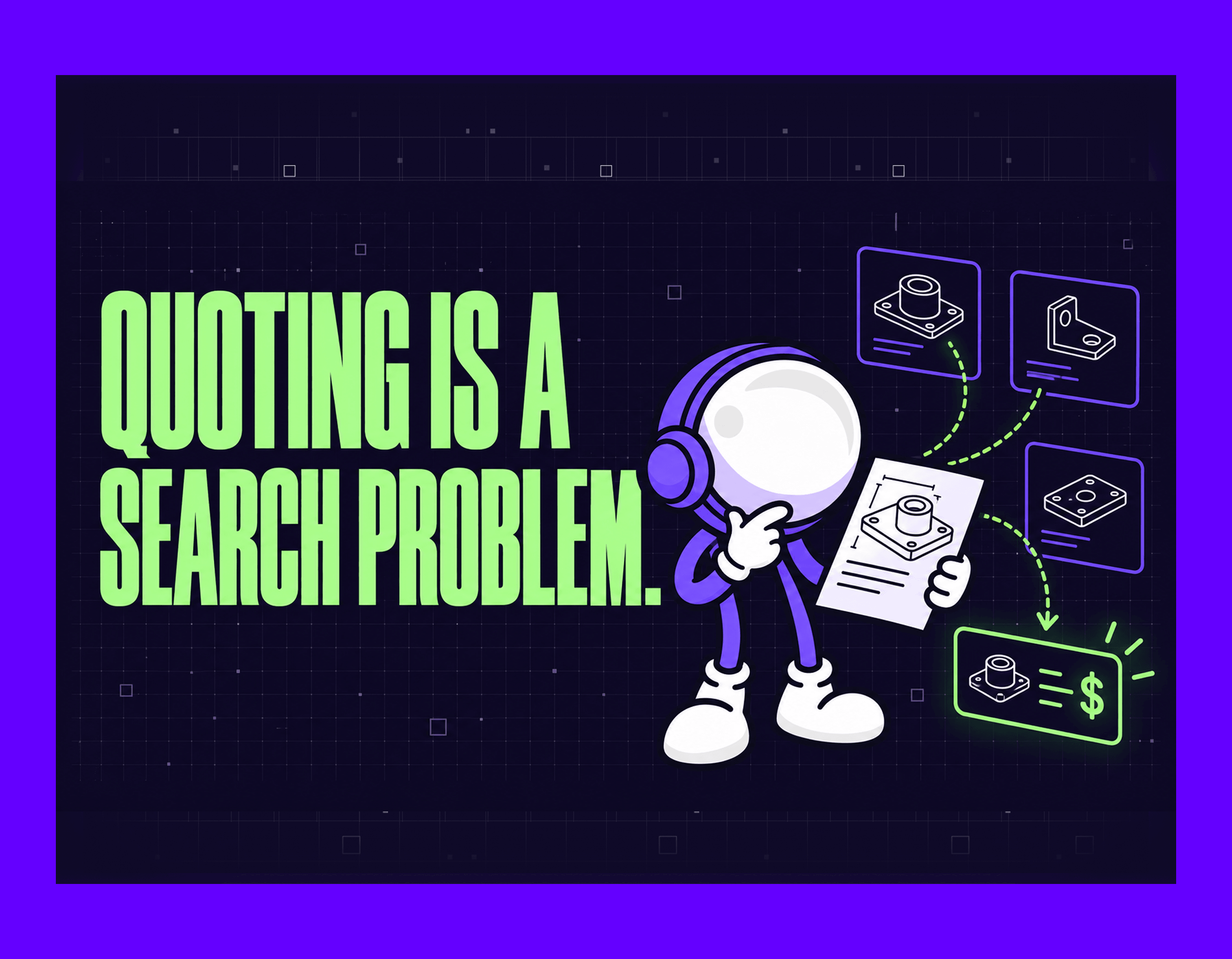
From the outside a late quote looks like a calculation problem. It is a search problem.
There is no spare engineer to put on the quoting desk
The obvious fix is to hire another engineer. For a manufacturing company in Lithuania that route is close to shut.
Figures from Lithuania's Employment Service show more than three thousand unfilled vacancies in the manufacturing sector (opens in new tab), with engineering technicians among the hardest roles to fill, and demand for highly qualified specialists up by close to a fifth over the year. Shortening the quoting queue by hiring works on paper and rarely in practice.
The same shortage carries a second risk. Where one person knows how to price, that person's holiday is a pause in the company's sales.
The basis for the price sits in finished jobs
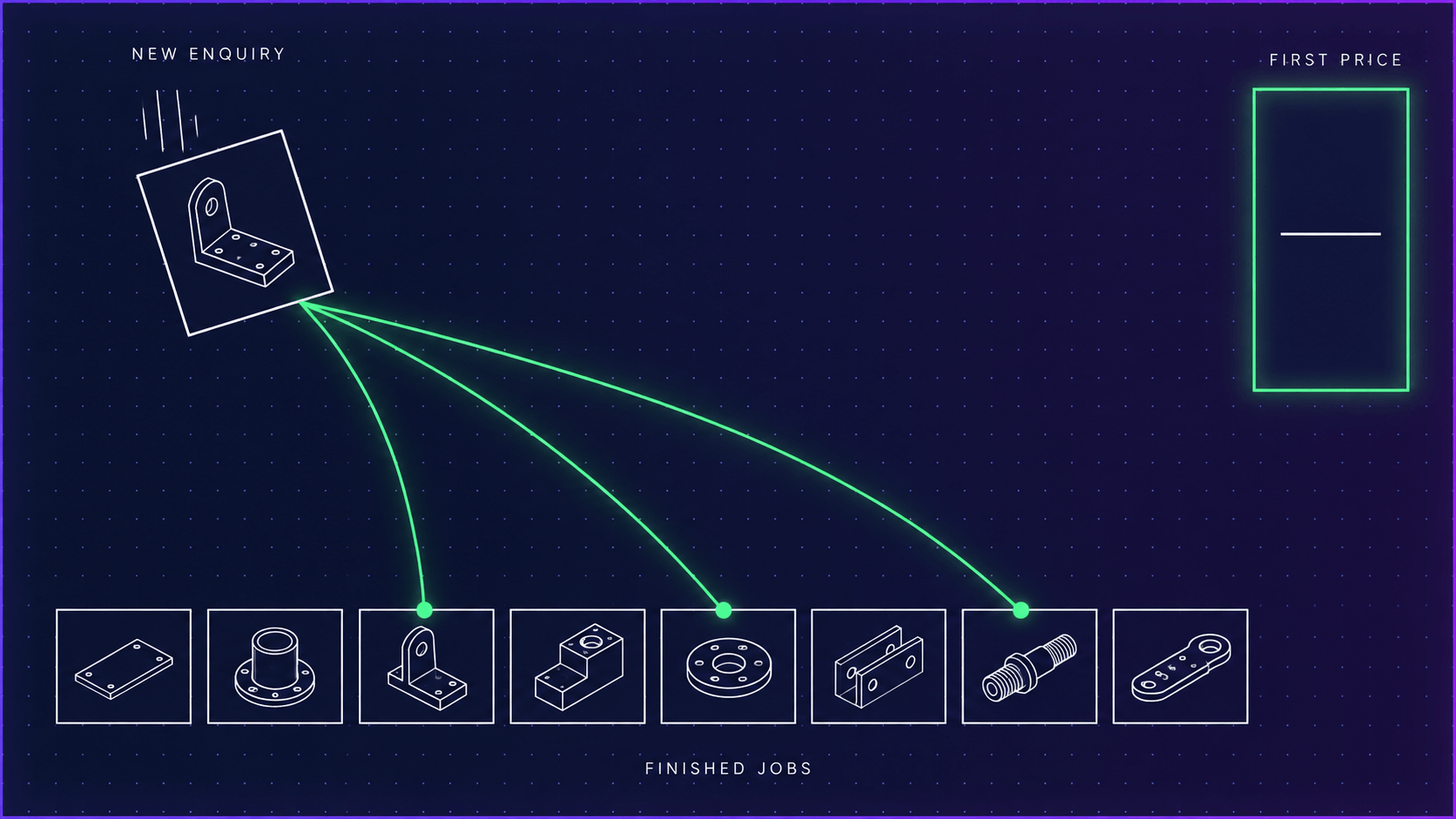
This is the point where an AI system does something a rule-based tool does not.
A rule needs a price list: a code, a line item, a price. Custom manufacturing has no such list, because every part is slightly different. What really determines the price lives in finished jobs: what a similar part cost, how many hours it actually took, how much material went to scrap. An AI system compares a new enquiry against earlier ones by similarity rather than looking for an exact code, so nobody has to write out every possible variant in advance.
The enquiry itself behaves the same way. It arrives in four shapes, and only one of them is ready to be priced.
How the enquiry arrives | What is already in it | What is still needed before pricing |
|---|---|---|
A drawing as a PDF | Dimensions, material, tolerances | Quantity, deadline, and whether this part was made before |
An email with a description | What the client wants in their own words | Almost every technical parameter |
The client's own spreadsheet | Quantities and the client's line names | A match between their names and yours |
A photo or a sketch | The shape and a rough idea | Everything else, usually over a phone call |
The client's own spreadsheet costs the most time and shows the least. A line is called one thing there and another in your system, and somebody has to decide that these are the same part.
What we saw in our own projects
What follows is our own work, which makes us the least neutral source you will read on it.
At one sheet metal products company we reworked order intake and price calculation. Headcount did not change. What changed was how many custom enquiries the same team could get through in a week, and how much administrative work sat around each order while they did it.
A second project, in steel products, was about the ERP and dispatch rather than quoting, and it lifted output by 15% while cutting dispatch time by 35%. Those two sides are connected directly, because a deadline in a quote is worth whatever the view of shop load is worth.
Both projects began with an audit rather than with code. What that looks like is set out on our case studies page (opens in new tab).
Frequently asked questions
How long does a project like this take? It starts with an audit, which comes in three sizes: Quick Look takes 5 working days, a Full Audit 2 to 3 weeks, a Deep Dive 5 to 6 weeks. The audit fee is credited against the implementation price. How long the build itself takes depends on what the audit finds, so we do not quote a number before it.
Will we have to change our ERP or accounting software? No. We connect to what is already running, and the route depends on what that software allows: a direct connection where one exists, a file import where it does not. That constraint shapes these projects more than any model choice does.
Will the system set the price by itself? No. It prepares a first version of the price and shows which earlier jobs it came from. The number that goes to the client is signed off by a person.
How many enquiries does a manufacturing company need before this pays off? Volume is the wrong thing to count. It matters more whether enquiries are sitting in a queue, whether two people price the same enquiry differently, and whether some enquiries never get answered at all.
What happens when an enquiry arrives in a form the system has not seen? It gets flagged and passed to a person along with whatever could be gathered from it. A price that was not guessed costs less than a price guessed badly.
When a manufacturing company should skip this
Three situations where automating the quote earns nothing, and one of them argues against the whole article.
The product range is narrow and stable. If you sell a few dozen standard items from a price list, pricing is already a solved problem. What that needs is a tidy table, not a system that can read.
Nobody has written the pricing rules down. Where two people price the same part differently and both can explain why, automation will only spread the disagreement faster. The agreement has to come first, which is the case we made separately when writing about how to check whether automation will pay off (opens in new tab).
A slow quote is a deliberate choice. Some manufacturers are in no hurry to send a price, because a fast answer attracts small, unprofitable enquiries. If slowness is working as a filter for you, make that filter an explicit criterion and then answer quickly.
Where to start
Take the last ten custom enquiries and write two dates against each: when it came in and when the price went out. Then mark what took longest in between: understanding it, searching for a comparable job, calculating, or agreeing the date with the shop.
Where searching takes longest, the answer is the archive and a way to find similar jobs inside it. If agreeing with the shop takes longest, shop load has to become visible before quoting is worth touching.
Get in touch (opens in new tab) and we will go through those ten enquiries with you, then say which part of it is worth automating in your case.
Gabriele J.
Marketing Specialist