Black Friday: What to Fix in Your Processes First
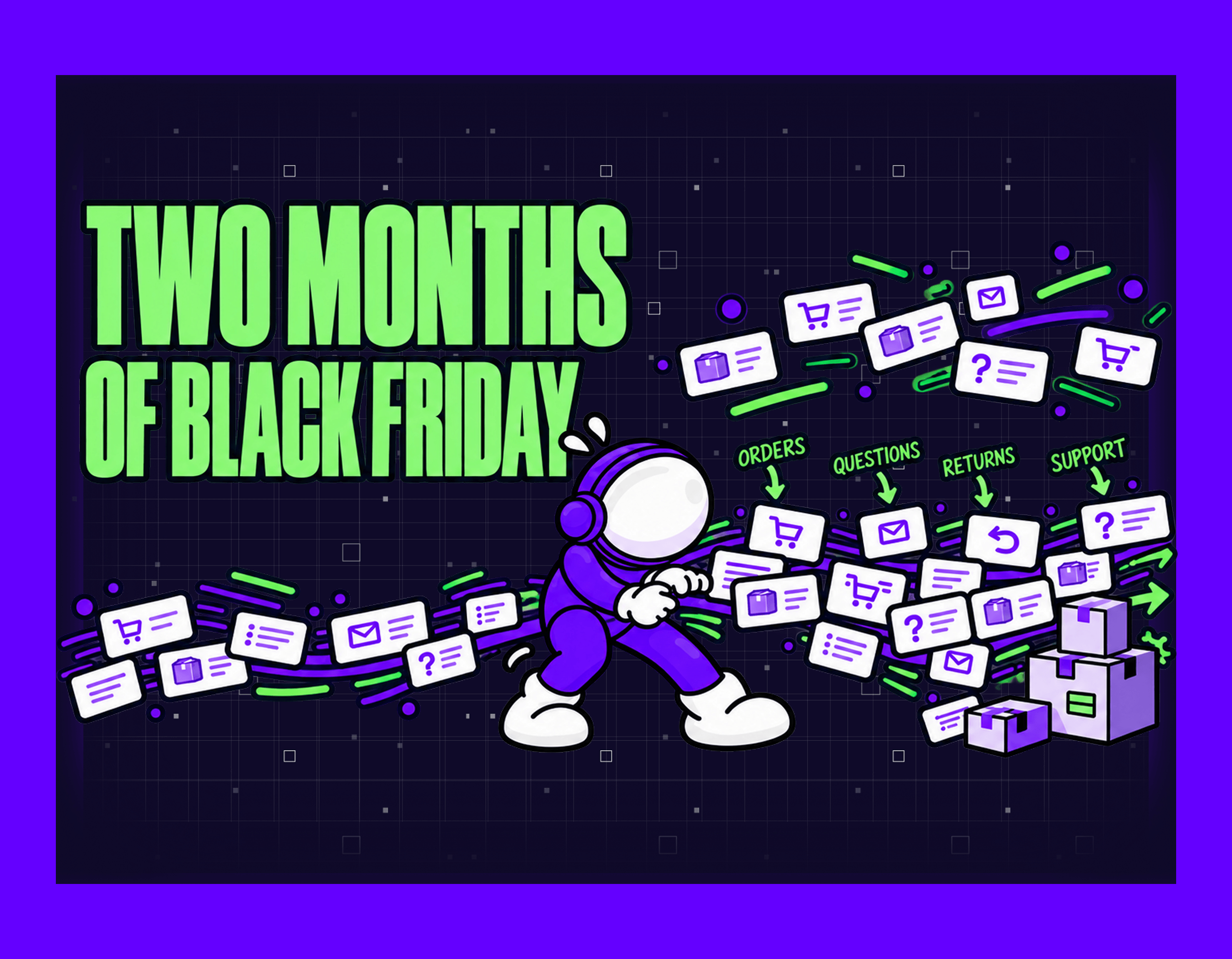
Black Friday is not a single day your processes have to survive. In Lithuania the discount season lasts through November and December, and a load that long cannot be covered with temporary hires. This article covers where that load lands first, why extra people do not always help, what you can still fix, and what is not worth starting this year.
Where a Black Friday peak lands first
None of the five things below is new work that appears in November. The company does all of them all year round, and at ordinary volume they simply do not show.
One person who approves the unusual cases. In an ordinary month they answer quickly, so nobody even notices that a case was waiting. At a peak so many of those cases build up that each one waits longer, not because the person has slowed down, but because there are too many for one pair of hands.
The same few customer questions, asked over and over. On an ordinary day a handful arrive and somebody answers them between other tasks. In November so many of those same questions come in that they take up the whole day, and everything else stops.
Orders arriving through several channels. On an ordinary morning somebody sorts them quickly and that is the end of it. At a peak there are so many orders that the sorting alone becomes a job of its own, one nobody was assigned.
Moving data from one system to another. For a single order it is a few minutes, and normally whoever is less busy does it. At a peak there are so many orders that those few minutes add up to hours, and nobody has spare hours then. The work either gets pushed into the evening or does not happen at all.
December returns. Every return is a separate decision: refund the money, exchange the item, or put it back into stock. In an ordinary month they arrive one at a time and get settled calmly. After a peak they come back almost all at once, and at the point when the team already thinks the season is over.
These five jobs enter the season plan unevenly. Returns are usually forgotten altogether, because they land when it looks as though the season has finished. The other four do get planned, but at the size they are in an ordinary month, and that is where the mistake sits: in an ordinary month people do part of that work in passing, with nothing written down, so on paper the jobs look smaller than they are. At a peak it is exactly that unrecorded part that grows the most.
Why extra people are not the first answer
The most obvious answer to two busy months is a temporary hire. Where the work is only volume, moving data between systems for example, that genuinely helps. Elsewhere it helps less than expected. At a peak the first thing to run short is the time to look into unclear cases, and that is the very part a temporary hire cannot take over, because they do not know how the company works yet.
In an ordinary month, when something is missing from an order, say the size of the item or the exact delivery address, somebody simply calls the client and checks. In November there is no time for that call, so the order either waits or somebody guesses what the client meant. That is why, before a peak, it matters more to watch how fast the cases needing a person's decision grow when orders double than to watch how many orders a system handles in a day.
How many such cases appear depends a great deal on how the process is automated. A rule-based tool hands a person everything no rule was written for in advance, and nobody writes out every case a season brings. So the cases landing on a person grow at exactly the same rate as the orders: more orders, more cases to settle by hand.
An AI system works differently. It hands a person only the cases that are unlike the ones settled before, and there are far fewer of those. What matters most is that there are not more of them simply because there are more orders: the familiar cases arrive in greater numbers, and the system handles them itself.
In an ordinary month that difference is invisible. Across two busy months it decides everything, and that is why Black Friday is a question of process rather than capacity.
This is also one more place where a well-tuned AI system pays off better than a temporary hire. Somebody taken on for the season begins to understand how the company works once the season is already under way.
What you can still fix in the weeks that are left
There is still time to do things that genuinely help, as long as they are narrow and clearly defined: answers to questions the company has already answered in writing, orders collected from every channel into one place, one document type taken off somebody's desk. Each of those needs one to three weeks, provided the material already exists inside the company. At a peak work like that takes a real load off, so starting now is worth it.
If you only have time for one, pick the one that hurt most during last year's peak.
What is not worth starting this year
Automation before Black Friday is not the right move in every case. There are three situations where the most honest answer is to automate nothing.
The peak is not your problem at all. Think back to last November: if orders were answered the same day, and nobody worked evenings or took work home, your process holds up at a peak. Then automating because of the peak makes no sense, and something other than Black Friday is eating your time. Where to start looking for it is set out in repairing the process first (opens in new tab).
The peak happens once a year. An AI system built for one season will sit unused for the other eleven months, and nobody maintains an unused system. At next year's peak that system will be worse than having none, because it will be trusted while nobody has checked whether it still works.
The cheapest answer is a decision rather than a build. Before automating anything, write down what the company simply will not do in November: a report that can be paused, a price list that can be frozen, an order channel that can be closed for six weeks. A list like that costs nothing and takes effect the same day rather than in three weeks. Usually it is exactly then that it becomes clear which of the remaining jobs is worth automating at all.
Where to start
Of those five jobs, the easiest to begin with is the repeating questions, the only one you can measure yourself without installing anything. Open last November in your inbox. Take the customer messages from the busiest week and mark every question you had already answered in some earlier message of your own. Then count how many you marked.
That number is the first piece of evidence worth having. A short list means repeat questions are not where your time goes. A long list is at once the argument for automating them and the material a system would learn from, because your earlier messages already are the answers.