Why Invoice Automation Should Be Your Starting Point

Why Invoice Automation Should Usually Be Your Starting Point
Every company we run a free diagnostic for has an opinion about which process hurts the most. Almost nobody leads with invoice automation. They point at client communication ("our inbox is a disaster"), at reporting ("nobody trusts the numbers"), or at production scheduling ("we're always firefighting"). Invoices barely make the list of complaints.
And yet, when we look at where automation actually pays off fastest, invoices win more often than any of the other five areas we map in a diagnostic. Not because they hurt the most, but because most invoices already follow a clean, repeatable pattern - which makes them the easiest place to prove that automation works before you bet real budget on the harder problems.
The loudest complaint isn't the right filter
In Where Your Team Loses Time to Manual Work (opens in new tab), we listed the six places manual work usually hides: documents and invoices, reports and KPIs, client communication, internal operations, sales and proposals, production and pricing. In diagnostic conversations, the loudest complaint and the best place to start rarely match. That's the wrong filter to rank them by.
The right filter, the one we walked through in Will Automation Pay Off? Check This First (opens in new tab), is exception rate: how often a real case deviates from the standard path. A process with a low exception rate is one where software can safely take over most of the volume, because most of the volume looks the same. A process with a high exception rate needs a person's judgment on nearly every case. Automate it too early, and the chaos just moves somewhere else, faster.
Internal operations often run on institutional knowledge that never got written down - who to call, which shortcut actually works, what the real exception process is. Production scheduling has to react to machines breaking down, materials arriving late, people calling in sick.
All three are worth fixing eventually. None is a good place to start an automation project, because the software has to get a lot of things right at once before anyone trusts it.
Why invoice automation usually wins the comparison
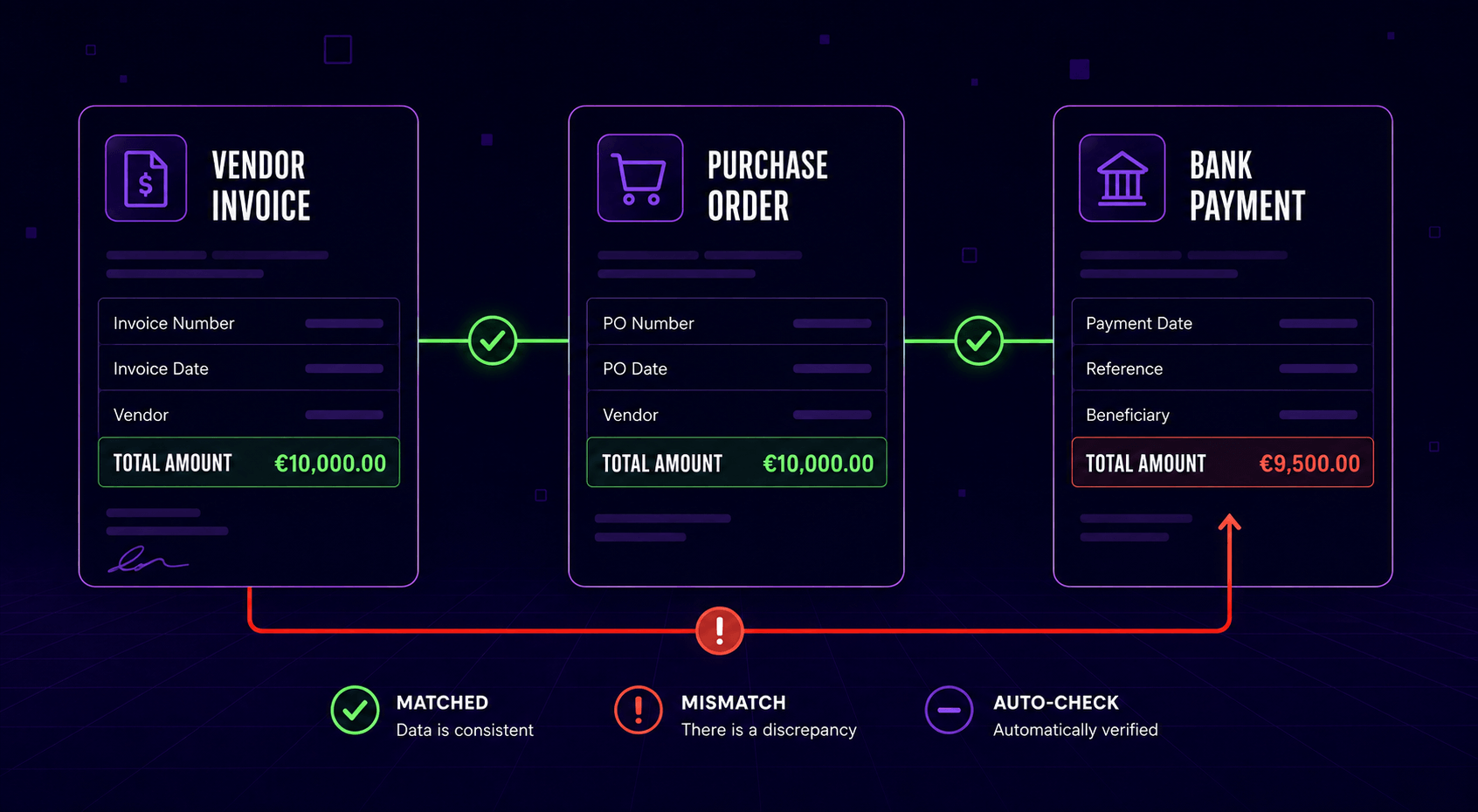
Invoices sit at the other end of that spectrum. A vendor invoice has a name, a date, a set of line items, a total. It either matches a purchase order and a bank payment, or it doesn't.
Accounts payable exception data (opens in new tab) backs this up with real numbers: on average, about 25% of invoices need manual exception handling, and an exception costs 4 to 6 times more to process than a clean one. That's a real, meaningful chunk of the work, but it also means the other 70-80% already follows a small, countable, repeatable set of patterns - a wrong VAT code, a duplicate, a missing PO. That's exactly the profile that made the quoting system we described in the exception-rate article work in the first place: high volume, few distinct reasons for deviation, each reason fixable on its own.
That's also why automating invoices tends to be a smaller, safer bet than automating client communication: the work is repetitive and rule-based, and most client conversations aren't.
What starting here actually gets you
We're not saying invoices are your biggest problem. We're saying they're usually the fastest place to get a real, measurable win - the kind of win that makes the next, harder automation project easier to approve internally, because now you have your own number instead of someone else's case study.
Here's what that's looked like in practice, on our own MYGOM Invoices (opens in new tab) product:
- -40% in invoice processing time
- 10x more invoices handled per person
- 95% accuracy on automatic reconciliation against bank payments
- -30% in the scattered software spend companies were previously stitching together to manage this manually
- $2,000+ saved on average for every duplicate payment caught before it went out
None of that required teaching a model to read a client's tone or predict when a machine will break down. It required matching structured documents against other structured documents - the kind of problem automation is genuinely good at today, without heroics.
When it isn't the right place to start
Not every company should start here. If you're a five-person company processing twenty invoices a month, this isn't where your time is going. The volume is too low for automation to be worth the setup, and your bottleneck is probably client communication or sales proposals instead. That's a completely valid answer.
This is the same honesty we try to build into every diagnostic: automation isn't always the answer. Sometimes it's a person, sometimes it's just leaving things as they are - and we'd rather tell you that upfront than sell you a tool you don't need yet.
How to check, without guessing
You don't need us to tell you whether invoice automation is your starting point. You can check in about three minutes with the free AI Diagnostic (opens in new tab). It walks through all six areas, not just this one, and gives you a straight, written verdict on where automation would actually help - not a generic score.
If invoices come out on top, you already know roughly what the upside looks like. If something else comes out on top, that's useful too. Better to find out in three minutes than after signing a contract. And if you'd rather talk it through first, get in touch (opens in new tab); sometimes a five-minute call answers it faster than a form.
Gabriele J.
Marketing Specialist