AI Tool With Your Company Context: What It Changes
AI Tool or AI System: When a Subscription Is Enough and When It Has to Know Your Company
A generic AI tool answers the question in front of it and forgets your company the moment the tab closes. An AI system built around your company keeps that context, connects to the systems where the work already happens, and repeats the same step every week without being asked. Both are worth paying for. The question is which of the two your case needs.
Anyone who has read what separates an AI agent from a rule-based tool (opens in new tab) already has half of this. That piece sorted systems by how they handle a document nobody described to them in advance. The question below arrives earlier in most companies: how much does the thing know about you before anybody types a word?
What a chat subscription is good at
Worth starting here, because the case against generic tools is usually overstated by the people selling the alternative.
A generic AI tool is good at work that begins and ends in one sitting. A first draft of an email you were going to rewrite anyway. A long PDF you paste in and want the gist of. An error message nobody on the team recognises. A translation that has to be readable rather than exact. For one person on one task it costs little and helps the same afternoon, which is why teams pick it up without anyone approving a project.
The limits show up on the second and third use. The same task next week starts from an empty window again. A colleague doing it writes a different prompt and gets a different answer. And anything that depends on facts held in your CRM, your accounting system or a folder of signed contracts has to be carried into the window manually, assuming the person knows where it lives.
The context somebody retypes every morning
Retyping the context never looks like a cost, because nobody was ever assigned it.
Before the tool helps with anything, somebody brings it up to speed. Who the client is. How your process actually runs. What you sell, at what price, and to whom. Then the tab closes and all of that is gone. Tomorrow the same person types a shorter version of the same briefing, and a colleague types a different one.
MIT's NANDA initiative measured what this adds up to across companies. Its 2025 report, The GenAI Divide: State of AI in Business (opens in new tab), puts 95% of organisations at zero return on their generative AI spending. The barrier it points at is learning: most of these systems "do not retain feedback, adapt to context, or improve over time". The same report found that only 40% of companies had bought an official subscription, while workers at over 90% of the companies surveyed were using personal AI tools for work regardless.
The sample is 153 senior leaders, 52 structured interviews and a review of more than 300 publicly disclosed initiatives, weighted towards large organisations, so it describes a pattern rather than your own proportion. The pattern is recognisable enough: the version people actually use is the one nobody configured, and none of that work accumulates anywhere.
An AI tool and an AI system, side by side
These are the checks we go through in a first conversation. Both columns describe how each side behaves today, not what a vendor deck promises for next year.
What you are checking | Generic AI tool | AI system built around your company |
|---|---|---|
Context | Typed in again every session | Held in one place and already loaded |
Your data | Only what somebody pastes in | Connected to the CRM, accounting and files in daily use |
Repeatability | Depends on who wrote the prompt that day | The same step runs the same way each time |
When somebody leaves | Their prompts and workarounds leave too | What they knew stays where the work happens |
Where it sits | In a chat window beside the process | Inside the process, started by an event |
Checking the output | Whoever remembers to check | A named person, on the cases the system marks |
The row about people leaving is the one companies notice last and feel longest. A resignation takes out the client history, the reasons behind old decisions and the small rules nobody wrote down, and a subscription holds none of it.
Two answers to the same client question
A client asks whether your product supports a particular integration. Two people answer, a week apart, from two different memories of the same project, and one of those memories is out of date. A chat window helps both of them write a clear and polite reply. It has no view on which reply is correct, because nobody told it what was built.
A system that holds the company context answers from the same source both times, and where the source is thin it says so rather than writing around the gap. Fast text and a dependable answer are two different products, and only the second one changes what your team can promise a client.
One example: the system our own team runs on
We built this one for our own team first, and it is the clearest example we can give without naming anyone.
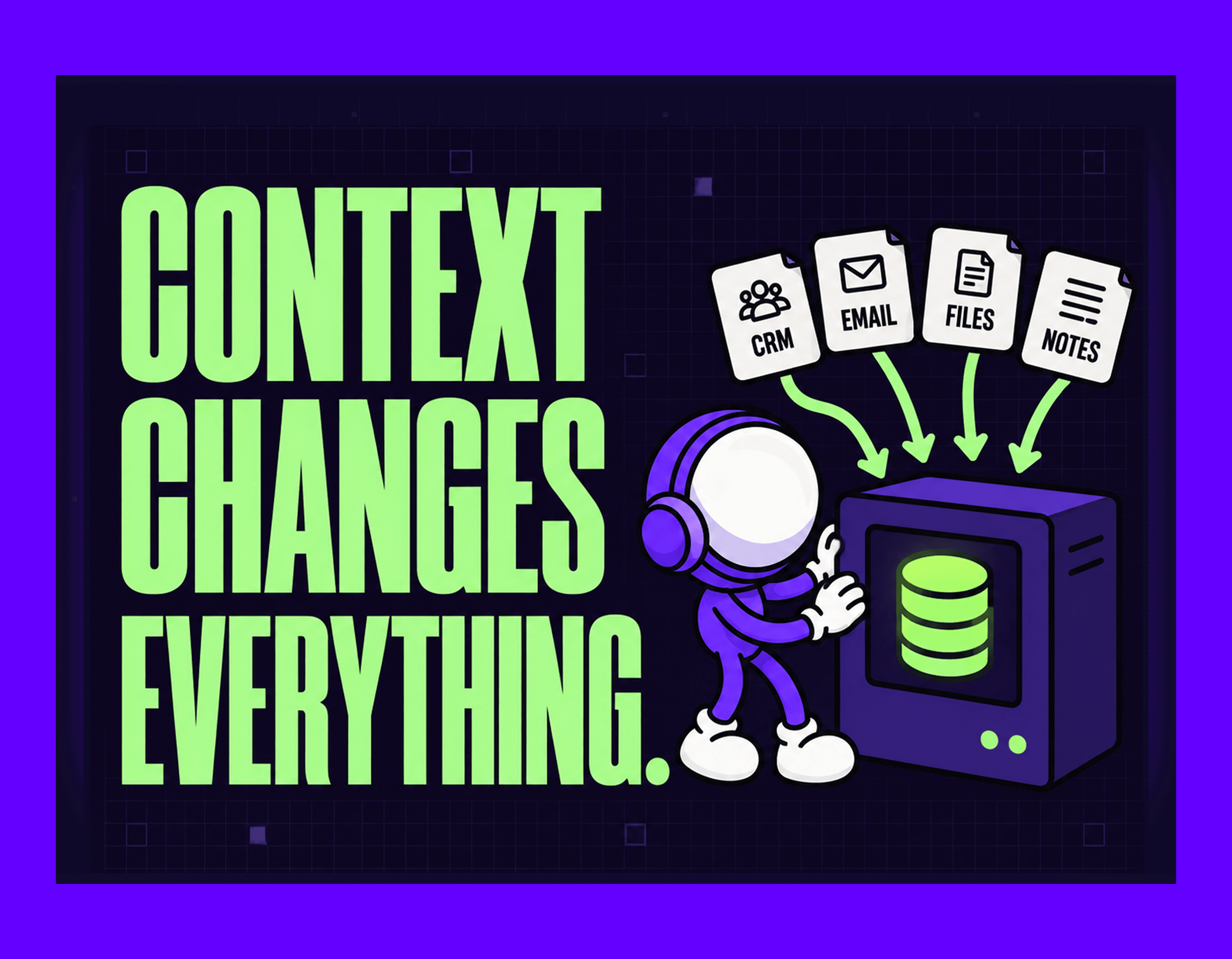
The system holds the company memory in one place: customers, projects, documents and the decisions behind them. It connects to the tools where work already happens, the CRM, the mail, the calendar, the project boards and the finance system, so nobody has to move to a new platform to use it. People and agents then work from one shared context instead of from whoever happens to remember. We call it the AI Business Brain, and our own team runs on it.
We have published no figure for this one, so there will be no figure here. What we can describe is the change in the question people ask. It moved from "who would know this" to "what does the system say", and the first version of that answer now arrives with the records it came from attached.
When a subscription is all a company needs
Some companies should buy licences, use them well and stop there.
If the work is personal and ends when the laptop closes, the context never had to be shared in the first place. A draft, a translation, a summary before a meeting: a subscription covers all of it, and building anything around it would add cost with nothing on the other side.
If four people work in one room and talk all day, the shared context already exists and it is the room. Systems earn their keep once that context has to survive a handover, a holiday, a second office or a person who joins after the decisions were made.
And if nobody has tried the generic version yet, start there. A company that has not found the places where the chat window lets it down cannot describe what a system would have to do differently. One month of subscriptions and an honest list of the moments it failed is the cheapest way to find that out.
Where to start
For one week, write down every time somebody pastes company context into a chat window: who the client is, how the process runs, what was agreed last month, what the price was. Nobody has to change how they work. The point is only to catch the moment.
That list is the specification. It shows what your company needs an AI system to know, and how often it needs to know it. If the list turns out short, the week is going somewhere else, and the faster next step is the six areas where teams lose time to repeated work (opens in new tab).
Get in touch (opens in new tab) and we will read the list with you.