Invoice Processing: 5 Questions Before You Automate
Invoice Processing: Five Questions Companies Ask Before Automating It
Most invoice processing projects stall on the same five questions, and none of them are about whether the technology works. They are about the accounting software, the archive, the timeline, the volume, and the accountant. Below we answer each of them.
We have written about why invoices are usually the first process worth automating (opens in new tab), and separately about the system we built ourselves. This article picks up where those leave off, with the practical objections that come next.
Do we have to change our accounting software?
No. This is the most common reason people postpone the conversation, and it comes from looking for the work in the wrong place.
The manual effort is almost never inside the accounting software. It is in everything that happens before the data reaches it: the document arriving by email, someone opening it, reading the supplier, the amount, the VAT and the dates, then typing those into a system that was perfectly capable of storing them all along.
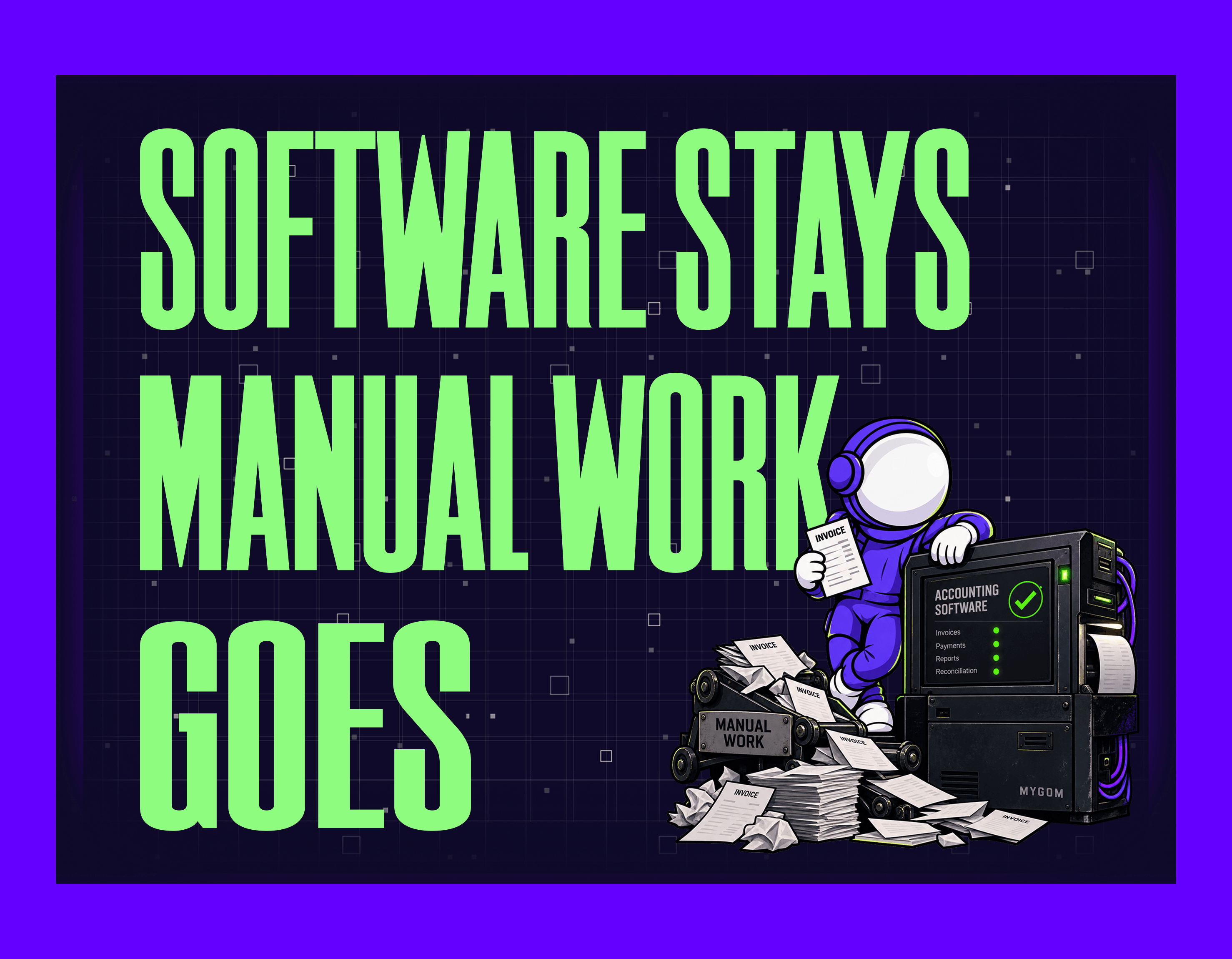
Automation replaces that middle step. Manual invoice entry disappears; your accounting software keeps doing what it already does and receives clean data instead of keyed-in data.
How that connection is made depends on what your accounting software allows. Some have an interface that accepts data directly. Some take a file import. Either way the data lands in the system you already use, in the format it already expects, so nothing about your setup has to be replaced.
If you are selling to the Lithuanian public sector there is one format requirement worth knowing separately: buyers and suppliers are required to submit and receive electronic accounting documents through SABIS (opens in new tab), the shared invoice administration system run by the National Centre for General Functions. That is a delivery channel obligation, not a reason to replace your accounting system.
What happens to the invoices we already have?
Usually nothing, and that surprises people.
An automation project starts with the flow of new documents, because that is where the recurring cost is. Processing a five year archive is a separate decision with a separate justification, and most companies find they do not need it. The archive is usually searchable enough for the rare occasions anyone goes looking.
There is one case where it is worth doing: if you are trying to find patterns across past spending, such as duplicate subscriptions or suppliers you are paying twice under slightly different names. That is a one-off analysis rather than an ongoing system, and it can be scoped on its own.
Worth clearing up a related worry: the system works without your archive. It reads the structure of a document rather than the history of your company, so it handles a supplier it has never seen before on day one.

How long does this actually take?
Longer than a demo suggests and shorter than an ERP project. The honest answer depends on how much of the process needs examining first. Here is how long each stage takes with us.
Stage | How long | What you get |
|---|---|---|
Free diagnostic | About 3 minutes | A written verdict on whether this is worth doing at all |
Quick Look | 5 business days | One engineer's read on a single process |
Full Audit | 2 to 3 weeks | A structured review of the whole process |
Deep Dive | 5 to 6 weeks | For processes where an error is genuinely expensive |
Implementation | Scoped from the audit | The working system, built by the same team |
Your own team's time is the part people underestimate in the wrong direction. During an audit it adds up to a few hours of conversation with the people who know the process, spread across the whole period.
What actually stretches a timeline is rarely the technical work. It is waiting for access to a system nobody remembers the credentials for, and waiting for a decision about who owns the exceptions once invoice processing stops being somebody's daily task. Both are worth sorting out early, because neither gets easier later.
At what volume is automating invoice processing worth it?
There is no threshold we can give you honestly, because volume is only half of the answer. A company handling 200 near identical invoices is a much better candidate than one handling 400 where every second invoice needs somebody to make a call.
Count two things instead:
- Volume. How many documents arrive in a normal month, across every channel they arrive through.
- Exception rate. Out of a hundred of them, how many follow the standard path without anyone having to decide anything.
High volume with a low exception rate pays back quickly. Moderate volume with a high exception rate usually does not, and the fix there is the process rather than the software. If you have never measured the second number, that is the first task, and it needs no tools.
For a reference point, Ardent Partners put the average invoice exception rate at 14% (opens in new tab) in its AP Metrics that Matter in 2025 report, with what the report calls best-in-class teams at 9%. If your own count lands far above that, automated invoice processing is not the first thing to fix.
Will it replace our accountant?
No, and we have answered this one at length before, so the short version: the system handles reading, matching and flagging. Deciding whether a disputed invoice should be paid, whether a cost belongs to this project or the next one, or whether a supplier is worth keeping stays with a person. That reasoning is set out in how we built our AI invoice automation (opens in new tab).
What changes is what the accountant spends the day on. Reviewing forty exceptions is a different job from opening two hundred documents to find the forty.
When you should not automate invoice processing
Three situations where we say no, and we would rather say it now.
Nobody can describe the current process the same way twice. If two people give different accounts of the invoice approval route, automation will encode one of those versions and make the disagreement faster. Write the process down first.
The volume is genuinely small. In some companies the whole job takes under an hour a week. Software is not the answer to an hour a week.
A standard tool already does it. If your process looks like everybody else's, buying something off the shelf is the right call and we will tell you so.
Where to start
You do not need to have this figured out before you call. The free AI diagnostic (opens in new tab) takes three minutes and covers six areas, not just invoices. At the end you get a written verdict, and sometimes it says to leave things as they are.
If you would rather talk it through first, get in touch (opens in new tab).